

10 Essential Features Every Business Website Should Have in 2026

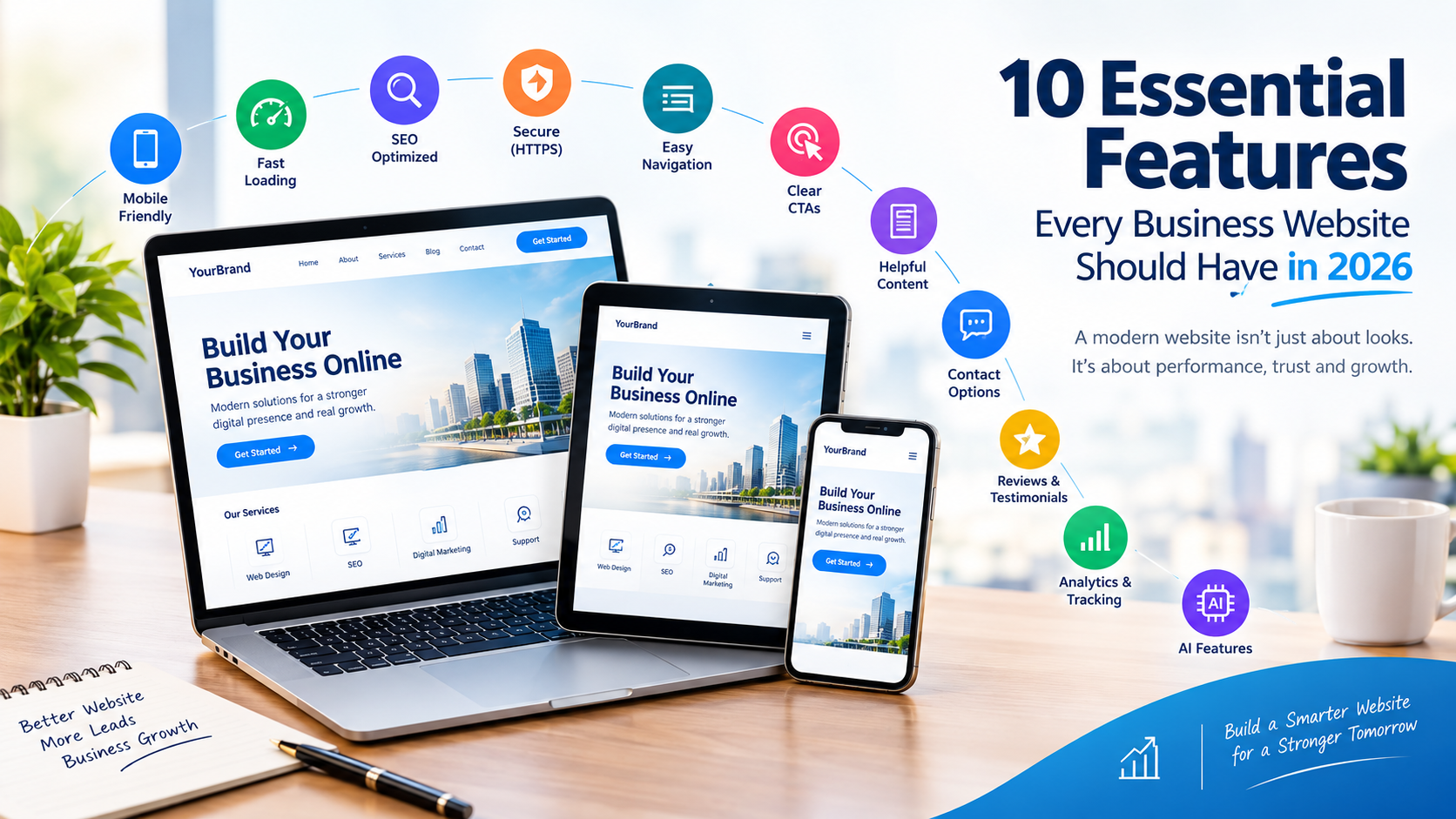
10 Essential Features Every Business Website Should Have in 2026
Last Updated: October 2026
A business website is no longer just an online brochure. In 2026, customers expect websites to be fast, secure, easy to use, mobile-friendly, and helpful from the moment they land on the page.
Whether you run a small local business, an e-commerce store, a professional service company, or a growing startup, your website can play a major role in generating leads, building trust, and converting visitors into customers.
But what makes a business website effective in 2026?
In this guide, we’ll explore the 10 essential features every business website should have in 2026 and explain why each one matters.
Table of Contents
Mobile-Friendly and Responsive Design
Fast Website Loading Speed
Clear Navigation and User-Friendly Design
Strong SEO Foundation
Clear Calls-to-Action
Secure HTTPS and Website Security
High-Quality and Helpful Content
Contact Forms and Multiple Contact Options
Social Proof, Reviews and Testimonials
Analytics and Conversion Tracking
Bonus: AI-Powered Website Features
Why These Website Features Matter
Frequently Asked Questions
Final Thoughts
1. Mobile-Friendly and Responsive Design
More people browse websites using smartphones than traditional computers. That makes responsive web design one of the most important features for any business website in 2026.
A responsive website automatically adjusts its layout, images, buttons, text, and menus according to the visitor's screen size.
Your website should provide a smooth experience across:
Smartphones
Tablets
Laptops
Desktop computers
A mobile-friendly website can also help improve user experience and support your SEO efforts.
Tip: Test your website on different screen sizes and make sure visitors can easily read content and click buttons without zooming.
2. Fast Website Loading Speed
Nobody likes waiting for a slow website to load.
Website speed affects user experience, engagement, and potentially your ability to convert visitors into customers. A slow website can cause visitors to leave before they even see your products or services.
To improve website performance, consider:
Compressing images
Using modern image formats
Reducing unnecessary plugins
Minifying CSS and JavaScript
Using browser caching
Choosing reliable web hosting
Using a Content Delivery Network (CDN)
A fast-loading website gives visitors a better experience and helps them find information quickly.
3. Clear Navigation and User-Friendly Design
Your visitors should not have to search through multiple pages to find basic information.
A business website should have simple and logical navigation. Important pages should be easy to find from the main menu.
Common business website pages include:
Home
About Us
Services
Products
Blog
Testimonials
Contact Us
FAQ
Keep your navigation simple and avoid overwhelming visitors with too many menu options.
A clean website structure helps users understand your business and move from one page to another easily.
4. Strong SEO Foundation
Having a website is not enough. People need to be able to find it through search engines.
Search engine optimization, or SEO, helps your website appear when potential customers search for products, services, or information related to your business.
A strong SEO foundation should include:
Keyword research
SEO-friendly URLs
Optimized title tags
Meta descriptions
Proper heading structure
Internal linking
Image alt text
Helpful, original content
Mobile-friendly design
Fast page speed
Technical SEO
Local SEO where applicable
For local businesses, optimizing your website for location-based searches can help attract customers from nearby areas.
5. Clear Calls-to-Action
What do you want visitors to do after visiting your website?
Your website should make the next step obvious.
Examples of effective calls-to-action include:
Get a Free Quote
Contact Us
Book a Consultation
Request a Callback
Buy Now
Download Now
Schedule a Demo
Get Started
Place relevant CTAs throughout important pages rather than forcing visitors to search for contact information.
A clear CTA can turn a website visitor into a potential lead or customer.
6. Secure HTTPS and Website Security
Website security is essential for every modern business website.
Your website should use HTTPS and have a valid SSL/TLS certificate. This helps protect data transferred between the website and visitors.
Businesses should also consider:
Regular website backups
Secure passwords
Software and plugin updates
Malware protection
Firewall protection
Secure hosting
Spam protection for forms
Security is particularly important for websites that collect customer information, process payments, or provide account logins.
A secure website also helps create trust with visitors.
7. High-Quality and Helpful Content
Your website content should answer the questions your customers are actually asking.
Instead of creating content only for search engines, focus on providing useful information for real people.
Your content can include:
Service descriptions
Product information
Buying guides
FAQs
Blog articles
Case studies
Customer success stories
Industry insights
How-to guides
For example, an interior design company could publish content about home interior costs, design ideas, material choices, and common renovation mistakes.
Helpful content can build authority, attract organic traffic, and support customers during their buying journey.
8. Contact Forms and Multiple Contact Options
Make it easy for potential customers to contact your business.
Depending on your industry, your website can include:
Contact forms
Phone numbers
Email addresses
WhatsApp buttons
Live chat
Appointment booking
Location and map
Social media links
Keep contact forms simple. Asking for too much information can discourage users from submitting them.
For lead-generation websites, a short form with fields such as Name, Phone Number, Email, and Requirement may be enough to start the conversation.
9. Social Proof, Reviews and Testimonials
People naturally want to know whether other customers trust a business before making a purchase or contacting a company.
Adding social proof can help build credibility.
Consider including:
Customer testimonials
Google reviews
Ratings
Case studies
Client logos
Before-and-after results
Awards and certifications
Project portfolios
Authentic reviews and real customer experiences can make your business appear more trustworthy.
Avoid using fake testimonials. Genuine customer feedback is much more valuable for long-term brand reputation.
10. Analytics and Conversion Tracking
A business website should not operate without knowing how visitors interact with it.
Analytics and conversion tracking can help you understand:
How many people visit your website
Where visitors come from
Which pages they view
How long they stay
Which pages generate leads
Which marketing channels perform best
Where visitors leave your website
Tools such as Google Analytics and Google Search Console can provide useful insights into website traffic and search performance.
For lead-generation websites, conversion tracking is especially important because traffic alone does not tell you how effectively your website generates business.
Bonus: AI-Powered Website Features
Artificial intelligence is becoming increasingly useful for business websites in 2026.
Depending on your business needs, you can consider AI-powered features such as:
AI chat assistants
Automated customer support
Smart product recommendations
AI-powered search
Personalized content
Automated FAQ assistance
Lead qualification
Appointment assistance
However, AI should improve the customer experience rather than make the website confusing or impersonal.
The best approach is to combine automation with easy access to human support when customers need it.
Why These Website Features Matter in 2026
A successful business website needs to do more than simply look attractive.
It should help visitors:
Find information → Understand your business → Trust your brand → Take action
The most effective websites combine good design, strong content, SEO, performance, security, and conversion-focused features.
If your website is missing several of these features, 2026 is a good time to review your website and identify areas that can be improved.
Frequently Asked Questions
What are the most important features of a business website in 2026?
Some of the most important features include responsive design, fast loading speed, easy navigation, SEO, clear calls-to-action, website security, useful content, contact options, social proof, and analytics.
Why is mobile-friendly design important for business websites?
A large number of users access websites through smartphones. A responsive design ensures that your website remains easy to use across different screen sizes and devices.
Does website speed affect SEO?
Website performance is one of the factors considered in Google's page experience systems. A faster website can also improve user experience and reduce the chances of visitors leaving because of slow loading.
How can a business website generate more leads?
A website can generate more leads by using clear CTAs, simple contact forms, strong service pages, trust signals, helpful content, mobile-friendly design, and conversion tracking.
Is SEO still important for business websites in 2026?
Yes. SEO remains an important way for businesses to increase their visibility in search results and attract people who are actively looking for relevant products, services, and information.
Should a business website have a blog?
A blog can be useful for publishing helpful information, answering customer questions, targeting relevant search queries, and supporting long-term organic visibility.
Final Thoughts
Your business website is often the first interaction a potential customer has with your brand.
In 2026, customers expect more than a basic website. They want a website that is fast, secure, mobile-friendly, easy to navigate, informative, and simple to use.
By implementing these 10 essential website features, businesses can create a stronger online presence, improve user experience, build trust, and create more opportunities for leads and sales.
The goal is not to add every possible feature to your website. Instead, focus on the features that genuinely help your customers and support your business goals.
A better website isn't just about looking professional — it's about helping your business grow.


Post a Review