
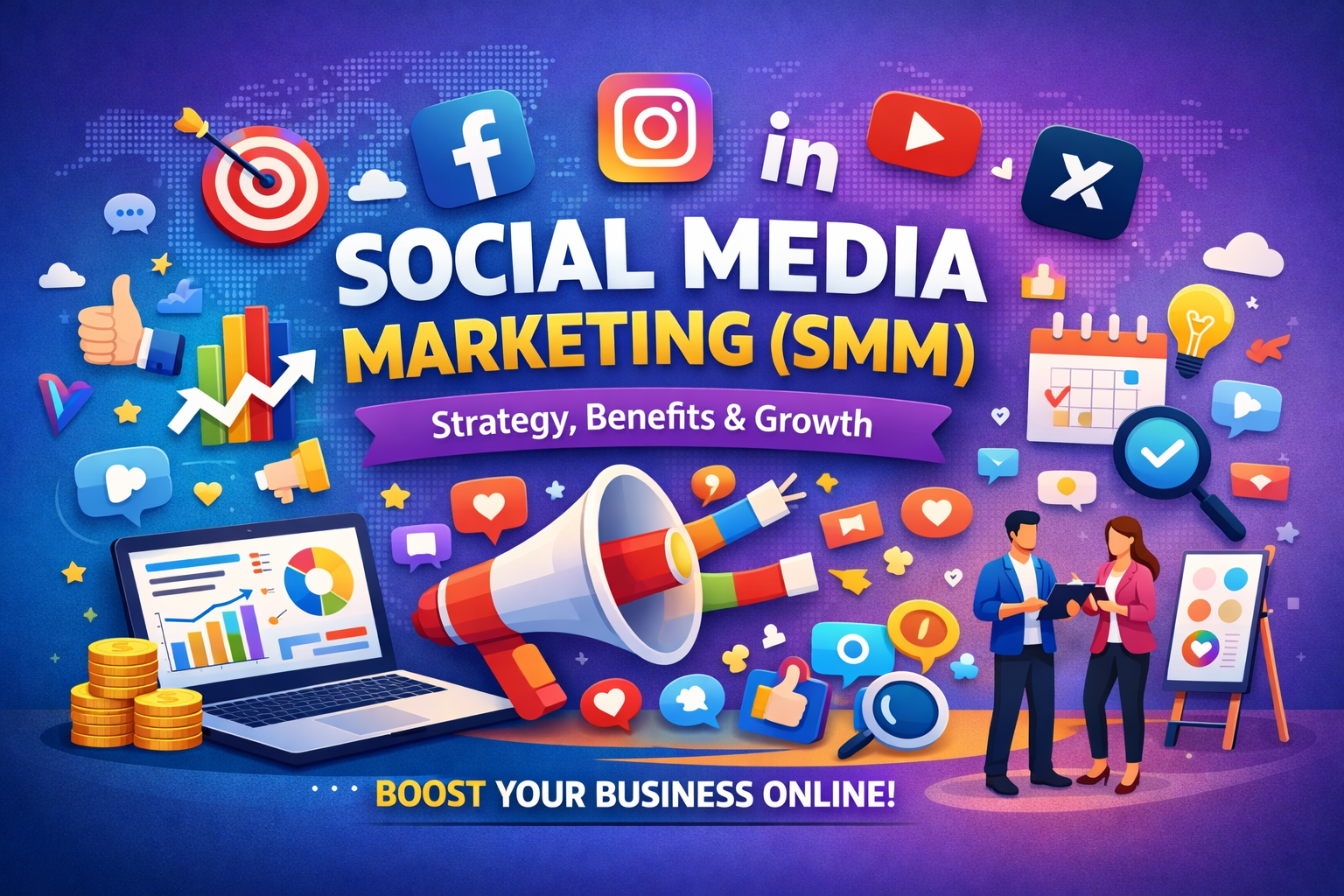
Social Media Marketing (SMM): Complete Guide to Strategy, Benefits, and Growth

Introduction to Social Media Marketing (SMM)
Social Media Marketing (SMM) is one of the most effective digital marketing strategies that helps businesses connect with their audience, build brand awareness, generate leads, and increase revenue through platforms like Facebook, Instagram, LinkedIn, X (Twitter), and YouTube.
Today, businesses of all sizes rely on Social Media Marketing (SMM) to engage customers in real time, promote products, and build long-term customer relationships. With the right strategy, SMM delivers measurable results, including traffic growth, conversions, and brand loyalty.
Blog Index: Social Media Marketing (SMM)
Introduction to Social Media Marketing (SMM)
What Is Social Media Marketing (SMM)?
How Social Media Marketing Works
Popular Social Media Platforms for Marketing
Facebook – Brand Promotion & Advertising
Instagram – Visual Branding & Reels
LinkedIn – B2B Marketing
YouTube – Video Marketing
X (Twitter) – Real-Time Updates
Effective Social Media Marketing Strategies
Social Media Marketing Metrics to Track
Organic vs Paid Social Media Marketing: Comparison
Role of AI and Analytics in Social Media Marketing
Best Practices for Successful Social Media Marketing
Frequently Asked Questions (FAQs) – Social Media Marketing (SMM)
Conclusion
What Is Social Media Marketing (SMM)?
Social Media Marketing (SMM) refers to the use of social media platforms to promote products, services, or brands through content creation, advertising, influencer collaboration, and community engagement.
It combines creative storytelling, audience targeting, analytics, and performance optimization to achieve marketing goals.
How Social Media Marketing Works
The process of Social Media Marketing (SnMM) involves several key steps:
Identifying target audience demographics and interests
Selecting the right social media platforms
Creating engaging content such as posts, reels, videos, and stories
Running targeted paid advertising campaigns
Tracking engagement, reach, and conversions
Optimizing campaigns based on performance data
Businesses often use analytics tools to measure results and continuously refine strategies.
Popular Social Media Platforms for Marketing
1. Facebook – Brand Promotion & Advertising
Best for: Businesses targeting a wide audience across different age groups.
Key advantage – Advanced audience targeting:
Facebook offers highly detailed targeting options such as age, gender, location, interests, behaviors, job roles, and purchasing patterns. This allows businesses to run highly focused advertising campaigns, increasing conversion rates. Facebook also supports multiple content formats, including posts, videos, stories, carousel ads, and lead-generation forms, making it ideal for both awareness and sales campaigns.
2. Instagram – Visual Branding & Reels
Best for: Lifestyle brands, fashion, beauty, travel, food, and e-commerce businesses.
Key advantage – High engagement rate:
Instagram is a visual-first platform where users interact heavily with reels, stories, and image posts. Creative visuals, short-form videos, influencer collaborations, and interactive features like polls or Q&A significantly improve engagement. Brands use Instagram to build a strong visual identity, increase brand recall, and drive website traffic through reels and story links.
3. LinkedIn – B2B Marketing
Best for: B2B companies, professional services, recruitment, and corporate branding.
Key advantage – Professional audience reach:
LinkedIn connects businesses directly with decision-makers, professionals, and industry leaders. It is highly effective for lead generation, employer branding, industry thought leadership, and networking. Companies often share case studies, research insights, whitepapers, and professional updates to attract business clients and partnerships.
4. YouTube – Video Marketing
Best for: Tutorials, product demonstrations, educational content, and brand storytelling.
Key advantage – Long-form content visibility:
YouTube allows businesses to create long-form video content that continues generating traffic for months or years through search visibility. Educational videos, how-to tutorials, product reviews, and explainer videos help build authority, trust, and audience loyalty while supporting both SEO and social media marketing strategies.
5. X (Twitter) – Real-Time Updates
Best for: News, trending topics, brand announcements, and customer engagement.
Key advantage – Trend-based engagement:
X (Twitter) is ideal for real-time communication, trending hashtag participation, and instant customer interaction. Brands use it to share updates, industry news, live event coverage, and customer support responses. Participating in trending conversations increases visibility and helps brands stay relevant in fast-moving digital discussions.
Effective Social Media Marketing Strategies
To succeed with Social Media Marketing (SMM), businesses should follow proven strategies:
1. Content Strategy Planning
Create a monthly content calendar including educational posts, promotional content, reels, stories, and customer testimonials.
2. Consistent Branding
Maintain consistent colors, logos, messaging, and brand tone across all platforms.
3. Paid Advertising Campaigns
Use targeted ads to reach the right audience segments based on demographics, interests, and behavior.
4. Influencer Collaborations
Partner with relevant influencers to increase credibility and reach new audiences.
5. Analytics and Performance Optimization
Track engagement metrics regularly and improve campaigns based on insights.
Social Media Marketing Metrics to Track
Comparison: Organic vs Paid Social Media Marketing
Role of AI and Analytics in Social Media Marketing
Modern Social Media Marketing (SMM) increasingly relies on AI-driven tools for audience analysis, content optimization, and performance prediction. Platforms such asWeb Digital Mantra, an AI-driven SEO & digital marketing platform, help businesses analyze website authority, track performance, and improve campaign effectiveness using intelligent insights.
For example, marketers often use tools like theDA PA Checker to evaluate website authority before planning content promotion and backlink strategies, ensuring stronger SEO and social campaign alignment.
Best Practices for Successful Social Media Marketing
Post consistently and maintain a content schedule
Focus on audience value rather than only promotions
Use video content for higher engagement
Respond quickly to customer comments and messages
Analyze monthly performance reports
Combine SEO and social mediastrategies for better results

Social Media Marketing dashboard showing engagement analytics across multiple platforms
Image Description: A digital dashboard displaying social media performance metrics such as engagement, reach, followers, and campaign analytics.

Image Description: Marketing professionals collaborating around a laptop while planning content calendars and social media campaigns.
Frequently Asked Questions (FAQs) – Social Media Marketing (SMM)
1. What is Social Media Marketing (SMM)?
Social Media Marketing (SMM) is the use of platforms like Facebook, Instagram, LinkedIn, YouTube, and X (Twitter) to promote brands, products, or services through organic content, paid ads, and audience engagement.
2. Why is Social Media Marketing important for businesses?
Social Media Marketing helps businesses increase brand awareness, connect with customers in real time, generate leads, drive website traffic, and build long-term customer relationships at a lower cost than traditional marketing.
3. How does Social Media Marketing work?
SMM works by identifying a target audience, creating engaging content, publishing it on suitable platforms, running targeted ads, tracking performance metrics, and optimizing campaigns based on analytics.
4. Which social media platform is best for marketing?
The best platform depends on business goals. Facebook is ideal for ads and wide reach, Instagram works best for visual and lifestyle brands, LinkedIn is effective for B2B marketing, YouTube supports long-form video content, and X (Twitter) is suitable for real-time updates and engagement.
5. What is the difference between organic and paid Social Media Marketing?
Organic SMM focuses on free content and audience engagement, while paid SMM uses advertising budgets to reach targeted audiences faster and drive immediate results like leads and sales.
Conclusion
Social Media Marketing (SMM) has become an essential growth strategy for modern businesses seeking visibility, customer engagement, and measurable ROI. By combining strong content planning, targeted advertising, analytics tracking, and AI-powered tools, organizations can build a powerful brand presence and sustainable digital growth.
Businesses that consistently invest in Social Media Marketing (SMM) strategies and performance optimization are more likely to achieve long-term competitive advantages in the digital marketplace.


Post a Review