

How to Count Backlinks and Build a Winning SEO Strategy for More Organic Traffic

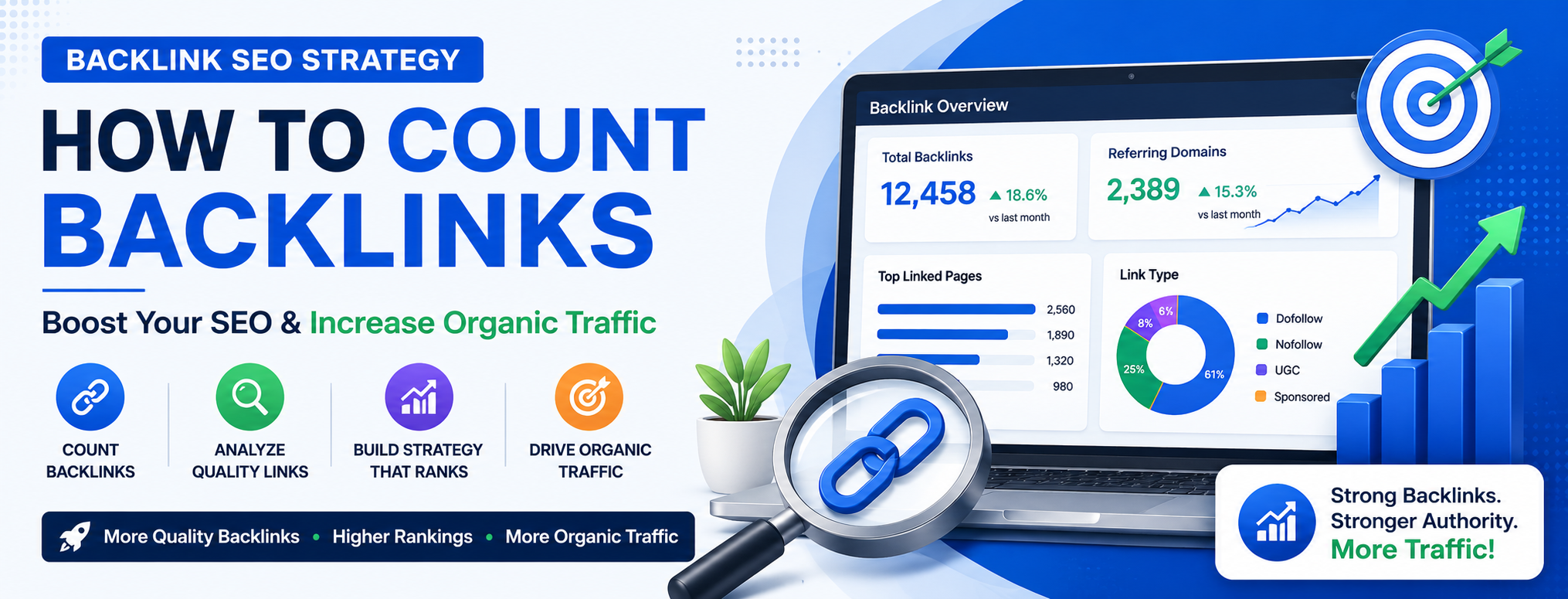
How to Count Backlinks and Build a Winning SEO Strategy for More Organic Traffic
Getting backlinks is only one part of off-page SEO. The bigger opportunity comes from understanding which websites link to you, what pages earn those links, and how those backlinks contribute to your organic search strategy.
This is why learning how to count backlinks should be part of every SEO campaign.
A website might have 20,000 backlinks and still struggle to generate organic traffic, while another website with 2,000 relevant backlinks could perform significantly better.
The difference often comes down to backlink quality, relevance, referring-domain diversity, content quality, and overall SEO strategy.
In this guide, you will learn how to count backlinks, use a backlink count checker, determine what counts as a backlink, understand social and redirected links, analyze competitors, and develop a backlink SEO strategy designed to support sustainable organic traffic growth.
Why Backlinks Matter for Organic SEO
Backlinks are hyperlinks from external websites that point to your website.
For example:
marketingwebsite.com/article → yourwebsite.com/seo-guide
The link pointing to your SEO guide is a backlink.
Search engines can use links to discover webpages and understand relationships between pages across the web.
But backlinks should never be viewed purely as numbers.
A successful backlink strategy focuses on earning relevant links from useful and trustworthy websites rather than generating thousands of low-value links.
Before planning a backlink campaign, you can analyze your website with Web Digital Mantra's Domain Authority Checker.
What Counts as a Backlink?
Understanding what counts as a backlink is the foundation of backlink SEO.
Generally, when another website contains a clickable hyperlink pointing to your website, that link can be considered a backlink.
For example:
Website A → Your Homepage
Website B → Your Blog
Website C → Your Service Page
Your website has received backlinks from three external sources.
Backlinks can originate from many places, including:
Blog articles
News websites
Business directories
Resource pages
Guest articles
Forums
Social networks
Online profiles
Images
Reviews
Community websites
However, backlinks from different sources should not automatically be assigned the same SEO value.
A relevant editorial link from a respected industry publication may be considerably more useful than numerous links from unrelated websites.
You can also analyze your website's authority metrics using Web Digital Mantra's DA PA Checker.
Why You Should Count Backlinks Before Building More
Many website owners immediately start link-building without understanding their existing backlink profile.
This can be a mistake.
Before building additional links, count backlinks and analyze what you already have.
Your backlink audit should answer questions such as:
How many backlinks does my website have?
How many referring domains link to me?
Which pages receive the most backlinks?
Which anchor texts are commonly used?
Which links are relevant to my niche?
Which links have disappeared?
Which competitors have stronger backlink profiles?
This information helps you develop a data-driven SEO strategy rather than randomly creating links.
For additional website analysis, use the Website Authority Checker.
How Does a Backlink Count Checker Work?
A backlink count checker uses backlink-index data to identify external webpages linking to a domain or URL.
Depending on the tool, you may receive information about:
Total backlinks
Referring domains
Linking pages
Anchor text
Link attributes
Authority metrics
New backlinks
Lost backlinks
Different backlink tools can produce different backlink counts because each provider maintains its own index and crawling system.
Therefore, backlink counts should generally be used for analysis and comparison rather than treated as a universal fixed number.
You can complement your backlink research using Web Digital Mantra's MozRank Checker.
Backlinks vs Referring Domains
This distinction is extremely important when developing your backlink SEO strategy.
Suppose Website A links to your website 200 times.
That could represent:
200 backlinks
but only:
1 referring domain
Now imagine 100 different relevant websites each link to you once.
That represents:
100 backlinks
and:
100 referring domains
The second backlink profile may offer greater link-source diversity.
Table 1: Backlinks vs Referring Domains
| SEO Metric | What It Measures | Example | Why Monitor It |
|---|---|---|---|
| Total Backlinks | Number of links pointing to your website | 5,000 | Shows overall link volume |
| Referring Domains | Unique websites linking to your site | 750 | Shows source diversity |
| New Backlinks | Recently discovered backlinks | 80 | Tracks backlink acquisition |
| Lost Backlinks | Previously detected links no longer found | 25 | Identifies lost opportunities |
| Anchor Text | Clickable words used in links | “SEO checker” | Helps analyze link context |
For broader website authority analysis, check your website using the Domain Authority and Domain Rank Checker.
How to Count Backlinks for Your Website
Counting backlinks should be part of a structured SEO audit.
Step 1: Enter Your Domain
Start with your root domain.
Example:
example.com
You can also analyze individual URLs when researching specific content.
Step 2: Check Total Backlinks
Record the total number of discovered backlinks.
Do not stop here.
A large number does not automatically indicate a strong backlink profile.
Step 3: Check Referring Domains
Determine how many unique domains are responsible for those backlinks.
Step 4: Identify Your Most Linked Pages
Look for pages attracting the largest number of external links.
These pages can reveal which topics, resources or tools are most linkable.
Step 5: Review Link Quality
Evaluate:
Website relevance
Page relevance
Link placement
Anchor text
Link attributes
Overall website quality
Step 6: Monitor Authority
Use Web Digital Mantra's DA PA Checker for SEO Growth to complement your backlink analysis.
Do Social Media Links Count as Backlinks?
A frequently searched question is:
Do social media links count as backlinks?
A clickable link from a social media platform to your website is technically an external link.
For example:
Social Profile → Your Website
Social Post → Your Blog
However, social media links should not automatically be considered equivalent to contextual editorial backlinks.
Social links can still contribute to:
Referral traffic
Brand visibility
Content distribution
Audience engagement
Content discovery
Website visits
Therefore, social media should be considered part of your broader content promotion strategy rather than simply a method for increasing backlink numbers.
Do Facebook Links Count as Backlinks?
Do Facebook links count as backlinks?
A clickable Facebook link directing users to your website can technically be considered an external link to your website.
Facebook links can appear through:
Facebook Pages
Posts
Public profiles
Shared articles
Groups
Comments
However, these links should not be treated exactly like independent editorial backlinks.
Facebook can instead be particularly useful for distributing content and generating referral traffic.
For example, you publish:
“100 SEO Statistics for 2026”
You promote the article through Facebook.
Marketing professionals discover the resource.
A blogger later references your statistics in their own article and links to your website.
The Facebook exposure helped create the opportunity, while the independent website created the editorial backlink.
This is why social media and link-building can work together.
Do Reddit Links Count as Backlinks?
Do Reddit links count as backlinks?
Yes, Reddit posts and comments can contain clickable external links pointing to websites.
However, Reddit is a user-generated content platform.
Links from user-generated areas should therefore be evaluated differently from independently published editorial links.
Instead of using Reddit purely to create backlinks, use it to:
Participate in relevant discussions
Answer questions
Share genuinely useful resources
Research audience problems
Discover content ideas
Generate relevant referral traffic
Avoid repeatedly posting promotional links.
Your goal should be to become genuinely useful within a community.
Do Redirects Count as Backlinks?
Another important SEO question is:
Do redirects count as backlinks?
A redirect itself is not a newly earned backlink.
Consider this situation:
External Website → Old URL → 301 Redirect → New URL
The backlink originates from the external website and points to your old URL.
The redirect then sends visitors and crawlers to the new destination.
Proper redirects are particularly important when:
Migrating websites
Changing domains
Updating URL structures
Combining similar pages
Deleting outdated pages
Moving from HTTP to HTTPS
If an old URL has valuable backlinks, redirecting it appropriately to a relevant replacement can help preserve continuity for users and search engines.
Avoid redirecting every deleted page to your homepage without considering relevance.
What Makes a Backlink Good for SEO?
If your objective is organic traffic, backlink quality should be prioritized over raw backlink volume.
Table 2: Strong vs Weak Backlink Characteristics
| Factor | Stronger Backlink | Weaker Backlink |
|---|---|---|
| Relevance | Closely related industry | Completely unrelated niche |
| Placement | Contextual content placement | Random page placement |
| Website Quality | Useful established website | Low-quality spam site |
| Anchor Text | Natural and descriptive | Repetitive keyword stuffing |
| Traffic Potential | Relevant users may click | Little realistic referral traffic |
| Editorial Context | Naturally referenced | Artificially inserted |
| Source Diversity | Multiple relevant domains | Thousands from one domain |
A good backlink strategy should prioritize relevance, usefulness and editorial context.
You can monitor changes in website authority with Web Digital Mantra's Free DA PA Checker.
How to Turn Backlink Data Into Organic Traffic
This is where backlink counting becomes a real SEO strategy.
Instead of asking:
“How can I get 1,000 backlinks?”
Ask:
“Which pages should earn backlinks to increase organic visibility?”
Here is a practical strategy.
Strategy 1: Find Keywords With Ranking Potential
Start with pages already ranking somewhere below the top results for valuable keywords.
For example:
Keyword: backlink checker
Current position: 14
If the page has strong content but weaker authority compared with competitors, improving the content and earning relevant links may support its ability to compete.
Do not assume backlinks alone will fix rankings. Search intent, content quality, technical SEO and competition also matter.
Strategy 2: Identify Competitor Backlink Gaps
Analyze competitors ranking above you.
Look for websites linking to several competitors but not your website.
These websites may represent potential outreach opportunities.
For example:
Website A links to Competitor 1.
Website A links to Competitor 2.
Website A links to Competitor 3.
Website A does not link to you.
If you have a genuinely useful resource, Website A may become a potential outreach target.
You can compare website authority with the DA PA Checker Ranking Gap Guide.
Strategy 3: Build Linkable Assets
One of the most sustainable ways to increase backlinks is creating something worth referencing.
Examples include:
Free Tools
Useful online tools can naturally earn backlinks.
Examples:
Domain Authority Checker
Backlink Checker
Keyword Tool
SEO Audit Tool
Website Speed Tool
Web Digital Mantra's Domain Authority Checker is an example of a utility designed around a specific SEO need.
Original Statistics
Publish original or well-organized industry statistics.
Example:
“150 SEO Statistics Marketers Need to Know in 2026”
Journalists, marketers and bloggers may reference useful statistics in their own content.
Original Research
Conduct:
Surveys
Industry research
Case studies
Experiments
Data analysis
Unique data gives other publishers a reason to cite your website.
Comprehensive Guides
Create resources that answer a topic thoroughly.
Examples:
Complete Guide to Domain Authority
Technical SEO Checklist
Backlink Analysis Guide
Google Ranking Factors Guide
Strategy 4: Recover Lost Backlinks
You do not always need to build new links.
Sometimes you can recover links you previously had.
Backlinks may disappear because:
The linking article was updated
Your URL changed
The linking page was deleted
Your page returned an error
The website changed its content
If a valuable backlink disappears, investigate the reason.
When appropriate, contact the publisher or restore the relevant resource.
Strategy 5: Convert Unlinked Brand Mentions
Sometimes websites mention your:
Company
Product
Tool
Research
Founder
Brand
without linking to your website.
These are called unlinked brand mentions.
If the mention would genuinely benefit readers from a source link, contact the publisher and politely suggest adding your website as the reference.
Strategy 6: Improve Existing Content Before Outreach
Do not promote weak content simply because you want backlinks.
Before outreach, improve:
Content depth
Accuracy
Statistics
Visuals
Examples
Structure
Original insights
User experience
Ask yourself:
“Would I link to this resource if I owned another website?”
If the answer is no, improve it first.
Strategy 7: Use Internal Links After Earning Backlinks
Backlinks and internal links should work together.
Suppose your SEO statistics article earns 100 backlinks.
That article can internally link to important relevant pages on your website.
For example:
SEO Statistics Article
↓
DA PA Checker
↓
SEO Guide
↓
Backlink Resource
A logical internal-link structure helps users discover related pages and helps search engines understand relationships across your site.
You can explore Web Digital Mantra's guide on how DA PA checkers support modern SEO.
Strategy 8: Track Organic Traffic, Not Just Backlink Numbers
The ultimate objective should not be:
“Get more backlinks.”
Your objectives should connect to business and SEO outcomes such as:
Increase relevant organic traffic
Improve visibility for target searches
Increase qualified leads
Increase conversions
Strengthen topical authority
Build brand awareness
Suppose:
Month 1: 2,000 backlinks / 5,000 organic visits
Month 6: 3,500 backlinks / 12,000 organic visits
That trend is more meaningful than backlink growth alone.
But correlation does not automatically prove that backlinks caused all of the traffic increase.
Content improvements, technical SEO, demand changes and other factors may also contribute.
Backlink SEO Metrics You Should Track
Instead of tracking only total backlinks, build a simple SEO dashboard.
Monitor:
Total Backlinks
Shows overall backlink volume.
Referring Domains
Shows how many unique websites link to you.
New Backlinks
Shows newly discovered links.
Lost Backlinks
Shows links that have disappeared.
Top Linked Pages
Shows which content attracts links.
Organic Keywords
Shows the number of queries your website appears for.
Organic Traffic
Shows visits generated through organic search.
Conversions
Shows whether SEO traffic generates meaningful business results.
For another authority perspective, use Web Digital Mantra's MozRank Checker.
Common Backlink SEO Mistakes
Avoid these mistakes when trying to increase organic traffic:
Building backlinks only for quantity
Buying bulk spam links
Using exact-match anchors repeatedly
Ignoring referring domains
Creating irrelevant directory links
Spamming Reddit
Spamming social media comments
Ignoring lost backlinks
Ignoring content quality
Linking only to the homepage
Building links to irrelevant pages
Ignoring organic traffic after link-building
Google's spam policies specifically identify link spam practices intended to manipulate search rankings, so backlink acquisition should focus on genuine editorial value rather than manipulation.
External Resource: Google Search Central Spam Policies
How Often Should You Check Your Backlinks?
The ideal frequency depends on your website.
For a small website:
Once per month
For an actively growing website:
Every 2 to 4 weeks
For an SEO campaign:
Weekly or campaign-based
For a large website:
Weekly monitoring may be useful.
You do not need to obsessively count backlinks every day.
Focus on meaningful trends.
Web Digital Mantra's Website Authority and SEO Growth Guide can help you understand how authority metrics fit into broader SEO measurement.
Backlink SEO Strategy Checklist
Before launching your next link-building campaign, check:
☐ Count existing backlinks
☐ Analyze referring domains
☐ Identify top-linked pages
☐ Check competitor backlinks
☐ Find backlink gaps
☐ Identify lost backlinks
☐ Find unlinked brand mentions
☐ Create linkable content
☐ Improve existing content
☐ Build relevant outreach lists
☐ Use natural anchor text
☐ Strengthen internal linking
☐ Monitor keyword rankings
☐ Monitor organic traffic
☐ Track conversions
You can start your authority analysis with Web Digital Mantra's Domain Authority Checker.
Frequently Asked Questions
1. What counts as a backlink?
A backlink is generally a hyperlink from an external website pointing to your website or one of its pages. Backlinks may originate from blogs, news websites, directories, forums, social platforms, resource pages and other webpages. Their SEO value varies depending on relevance, context and quality.
2. Do social media links count as backlinks?
Social media links are external links pointing toward your website, but they should not automatically be treated like editorial SEO backlinks. They can still provide referral traffic, content exposure, audience engagement and opportunities for your content to be discovered by people who may later reference it.
3. Do Reddit links count as backlinks?
Reddit posts and comments can contain links to external websites. However, Reddit is primarily user-generated content, so these links should be evaluated differently from independently earned editorial backlinks. Use Reddit for genuine participation and useful content sharing rather than link spam.
4. Do redirects count as backlinks?
A redirect is not itself a newly earned backlink. If another website links to an old URL that redirects to a relevant new URL, search engines can follow the redirect and process the destination. Correct redirect implementation is especially important during URL changes and website migrations.
Conclusion
Learning how to count backlinks is useful, but successful backlink SEO requires much more than watching a number increase.
A strong strategy connects:
Backlinks → Quality Content → Authority → Search Visibility → Organic Traffic → Conversions
Use a backlink count checker to understand your current backlink profile, analyze referring domains, identify your most-linked content, discover lost links and compare competitors.
At the same time, understand what counts as a backlink and how different link sources behave.
Facebook and other social platforms can generate referral exposure. Reddit can help useful resources reach relevant communities. Redirects can preserve access to changed URLs. Editorial links can help establish relationships between useful resources across the web.
Your goal should therefore not be to generate the highest backlink number possible.
Build resources worth linking to, earn relevant links, strengthen internal linking, and measure whether those efforts contribute to meaningful organic traffic.
For Google's technical explanation of links and crawlable link structures, see the Google Search Central link best practices.
For ongoing website analysis, use Web Digital Mantra's Domain Authority Checker and evaluate your backlink growth alongside authority, rankings and organic traffic.


Post a Review