

Google Ads Promotion – The Complete Guide to High-Intent Traffic & Faster Business Growth

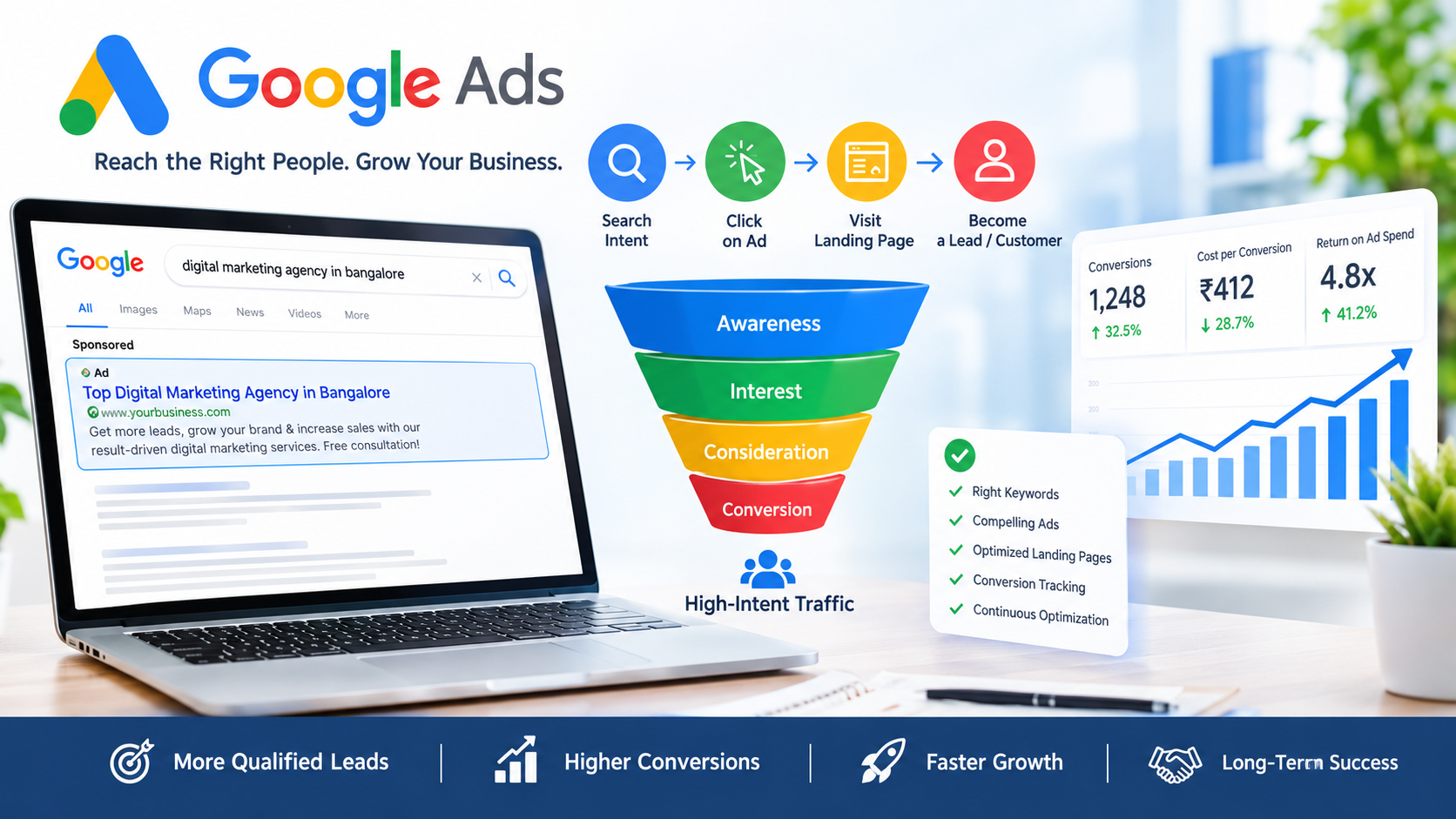
Google Ads promotion is one of the most effective ways for businesses to reach potential customers at the exact moment they are searching for a product, service, or solution. Unlike many traditional marketing methods, Google Ads can target users based on what they actively search for, making it a powerful channel for generating high-intent traffic, leads, sales, and enquiries.
Whether you run a local business, e-commerce store, service company, educational institution, or B2B business, a well-planned Google Ads campaign can help you reach the right audience faster.
But simply running an advertisement on Google does not guarantee results. Successful Google Ads promotion requires the right keywords, campaign structure, ad copy, landing pages, targeting, bidding strategy, conversion tracking, and continuous optimization.
In this complete guide, we'll explain how Google Ads promotion works, how to build campaigns, how to attract high-intent customers, common mistakes to avoid, and how businesses can use Google Ads for sustainable growth.
Table of Contents
- What Is Google Ads Promotion?
- How Does Google Ads Work?
- Why Google Ads Is Important for Businesses
- What Is High-Intent Traffic?
- Types of Google Ads Campaigns
- How to Choose the Right Keywords
- How to Create High-Converting Google Ads
- Landing Pages and Google Ads
- Google Ads Budget Planning
- Conversion Tracking
- Google Ads Optimization Strategies
- Common Google Ads Mistakes
- Google Ads vs SEO
- Google Ads for Local Businesses
- How Google Ads Helps Business Growth
- Google Ads Promotion Best Practices
- Frequently Asked Questions
- Final Thoughts
What Is Google Ads Promotion?
Google Ads promotion is a digital advertising method that allows businesses to display paid advertisements across Google's advertising network.
Depending on the campaign type, your ads can appear when users:
- Search for specific keywords
- Browse websites
- Watch YouTube videos
- Use Google Maps
- Explore products
- Use mobile applications
- Search for local services
For example, imagine a customer searches:
"Best digital marketing agency in Bangalore"
A business running a relevant Google Search campaign may have an opportunity to appear near the top of the search results.
This is valuable because the person is already looking for a solution. The business is not simply interrupting the user's browsing experience—it is responding to an existing demand.
How Does Google Ads Work?
Google Ads generally works through an advertising auction. When a user performs a search that matches eligible targeting, Google determines which ads can participate and how they are positioned.
Several factors can influence ad performance, including:
- Keyword relevance
- Ad quality
- Landing page experience
- Bid
- Expected performance
- Competition
- Search context
- Geographic and device-related factors
Therefore, having a high budget alone does not automatically guarantee better results.
A relevant campaign with strong ad quality and a useful landing page can potentially perform efficiently compared with a poorly structured campaign.
Why Is Google Ads Important for Businesses?
Businesses today compete for attention across multiple digital channels. Google Ads provides an opportunity to reach users who are already searching for something related to your business.
Key benefits include:
1. Reach Customers With Existing Demand
Search advertising can connect your business with users who are actively searching for your products or services.
2. Faster Visibility
SEO can take time to build organic visibility. Google Ads can provide paid visibility when campaigns are approved and eligible to serve.
3. Targeted Advertising
Businesses can refine campaigns using factors such as:
- Location
- Language
- Device
- Audience signals
- Keywords
- Search themes
- Time and other campaign settings
4. Measurable Performance
You can measure metrics such as:
- Impressions
- Clicks
- Click-through rate
- Cost per click
- Conversions
- Cost per conversion
- Conversion value
5. Flexible Budgeting
Businesses can set campaign budgets based on their marketing goals and adjust them as performance data becomes available.
What Is High-Intent Traffic?
High-intent traffic refers to visitors who demonstrate a stronger likelihood of taking a desired action because their search or online behaviour indicates an existing need.
For example:
Low-intent search:
"What is digital marketing?"
Higher-intent search:
"Digital marketing agency in Bangalore"
Strong commercial intent:
"Hire SEO agency Bangalore"
The second and third searches provide stronger signals that the user may be researching providers or considering taking action.
This is why keyword selection is one of the most important parts of Google Ads promotion.
Types of Google Ads Campaigns
Google Ads offers different campaign types for different marketing objectives.
1. Search Campaigns
Search campaigns allow businesses to show text ads when people search on Google for relevant terms.
They are particularly useful for:
- Lead generation
- Service businesses
- Local businesses
- Enquiries
- High-intent searches
2. Display Campaigns
Display advertising can help businesses reach people across websites and apps within Google's advertising network.
Display campaigns can be useful for:
- Brand awareness
- Remarketing
- Product promotion
- Audience reach
3. YouTube Advertising
Video advertising can help businesses reach potential customers through YouTube.
It can support:
- Brand awareness
- Product demonstrations
- Educational content
- Remarketing
- Lead generation
4. Shopping Campaigns
For eligible e-commerce businesses, Shopping campaigns can showcase products with information such as product images, names, and prices.
These campaigns can help customers discover products while researching what to buy.
5. Performance Max Campaigns
Performance Max campaigns can access multiple Google advertising channels through a single campaign.
Businesses can use them when their objectives and conversion tracking are suitable for this campaign approach.
How to Choose the Right Google Ads Keywords
Keywords connect what users search for with the products or services businesses promote.
Before selecting keywords, understand your customer's:
- Problem
- Need
- Search behaviour
- Buying stage
- Location
- Product or service category
Example
Suppose you operate a website design company in Bangalore.
Potential keywords could include:
- website design company Bangalore
- web development company Bangalore
- business website development
- website development services
- professional website design Bangalore
However, don't simply add hundreds of keywords.
Focus on relevant search terms that align with your products, services, and landing pages.
Search Intent and Keyword Selection
Understanding search intent can make your Google Ads campaign more relevant.
Informational Intent
Users are looking for information.
Examples:
- What is SEO?
- How does Google Ads work?
- Benefits of digital marketing
Commercial Investigation
Users are comparing solutions.
Examples:
- Best SEO services
- Google Ads agency comparison
- Digital marketing companies
Transactional Intent
Users are closer to taking action.
Examples:
- Hire Google Ads agency
- Buy accounting software
- Digital marketing services Bangalore
For lead generation campaigns, commercial and transactional searches may be particularly relevant, depending on your business model.
How to Create High-Converting Google Ads
Your ad needs to quickly communicate why the user should click.
A strong ad generally aligns:
Keyword → Ad Message → Landing Page → Conversion Action
For example:
Headline Ideas
Google Ads Services in Bangalore
Generate More Qualified Leads
Performance-Focused Google Ads Management
Description Example
Reach potential customers searching for your services on Google. Get professionally managed campaigns focused on relevant traffic, leads and measurable results.
CTA Ideas
- Get a Free Consultation
- Request a Quote
- Contact Us Today
- Book a Consultation
- Learn More
Avoid making unrealistic promises such as guaranteed rankings, guaranteed leads, or guaranteed sales.
Landing Pages: The Hidden Factor Behind Google Ads Performance
Getting clicks is only part of the process.
If your landing page is confusing, slow, irrelevant, or difficult to use, visitors may leave without taking action.
A good landing page should clearly communicate:
What do you offer?
Explain the product or service immediately.
Who is it for?
Identify the type of customer you serve.
Why should customers choose you?
Highlight relevant benefits, experience, features, or proof.
What should visitors do next?
Use a clear CTA such as:
Call Now | Request a Quote | Book a Consultation | Submit an Enquiry
Landing Page Checklist
- Mobile-friendly design
- Fast loading speed
- Clear headline
- Relevant content
- Strong CTA
- Simple enquiry form
- Trust elements
- Relevant images
- Easy navigation
- Accurate contact information
How Much Should You Spend on Google Ads?
There is no universal Google Ads budget that works for every business.
Your budget can depend on:
- Industry
- Location
- Competition
- Average customer value
- Keyword costs
- Conversion rate
- Business objectives
- Available marketing budget
Instead of asking only:
"How much should I spend?"
Ask:
"How much can I reasonably spend to acquire one customer?"
For example, if your average customer generates ₹20,000 in revenue, you can evaluate how much customer acquisition cost your business can sustainably support.
The goal should be profitable and measurable customer acquisition, not simply generating the largest number of clicks.
Google Ads Conversion Tracking
Conversion tracking is essential for understanding whether your campaigns are generating meaningful business results.
Depending on your business, conversions could include:
- Form submissions
- Phone calls
- Purchases
- WhatsApp enquiries
- Appointment bookings
- Sign-ups
- Quote requests
Without reliable conversion tracking, you may know that people clicked your ads but not whether those clicks generated business value.
This makes optimization much more difficult.
Google Ads Optimization Strategies
Launching a campaign is only the beginning.
Regular optimization can help improve campaign efficiency over time.
1. Analyze Search Terms
Review actual search queries and identify:
- Relevant searches
- Irrelevant searches
- New keyword opportunities
- Negative keyword opportunities
2. Improve Ad Relevance
Test different messaging based on:
- Customer problems
- Benefits
- Services
- Locations
- Offers
- Calls to action
3. Optimize Landing Pages
If you receive clicks but few conversions, investigate your landing page.
Check:
- Relevance
- Speed
- Mobile experience
- CTA visibility
- Form usability
- Content clarity
4. Monitor Conversion Cost
Don't focus only on clicks.
Monitor whether your campaigns are generating conversions at a sustainable cost.
5. Review Geographic Performance
If your business serves specific locations, regularly review where your traffic and conversions are coming from.
For example, a Bangalore-focused business should carefully review geographic targeting and location-related performance instead of assuming that all leads are from the desired service area.
Common Google Ads Mistakes to Avoid
Mistake 1: Targeting Too Broadly
Broad targeting can attract users who are not relevant to your business.
Mistake 2: Choosing Keywords Without Understanding Intent
High search volume doesn't always mean high business value.
Mistake 3: Sending All Traffic to the Homepage
A dedicated landing page can sometimes provide a more relevant experience.
Mistake 4: Not Using Negative Keywords
Negative keywords can help reduce irrelevant traffic.
Mistake 5: Ignoring Mobile Users
Many searches happen on mobile devices, so your landing page and conversion process should work smoothly on smartphones.
Mistake 6: Measuring Only Clicks
Clicks are not the final business objective.
Track meaningful conversions whenever possible.
Mistake 7: Making Unsupported Claims
Avoid exaggerated advertising claims such as:
- Guaranteed #1 position
- Guaranteed sales
- 100% guaranteed leads
- Instant results
Focus on accurate, supportable messaging.
Google Ads vs SEO: What's the Difference?
Google Ads and SEO can both help businesses gain visibility on Google, but they work differently.
| Google Ads | SEO |
|---|---|
| Paid advertising | Organic search visibility |
| Can provide faster visibility | Usually takes longer to build |
| Pay for advertising interactions based on campaign setup | No direct charge for each organic click |
| Highly controllable campaign targeting | Organic rankings depend on many factors |
| Requires ongoing advertising budget | Requires ongoing content and SEO work |
For many businesses, Google Ads and SEO can work together.
Google Ads can support immediate paid visibility, while SEO can build long-term organic search presence.
Google Ads for Local Businesses
Local businesses can use Google Ads to reach customers searching for nearby products and services.
Examples include:
- Restaurants
- Interior designers
- Education institutes
- Real estate businesses
- Digital marketing agencies
- Hospitals and clinics
- Salons
- Repair services
- Construction companies
- Financial service providers
For local campaigns, pay close attention to:
Location targeting + Search intent + Landing page relevance + Conversion tracking
This combination can help reduce irrelevant traffic and focus advertising on your intended service area.
How Google Ads Can Support Faster Business Growth
Google Ads can contribute to business growth by creating a measurable connection between:
Search Demand → Advertisement → Website → Lead → Customer
For example:
A potential customer searches for a service → sees your advertisement → visits your landing page → submits an enquiry → your sales team follows up → the lead becomes a customer.
The advertising platform generates the opportunity, but the final business result also depends on factors such as:
- Product quality
- Pricing
- Landing page
- Sales process
- Customer service
- Follow-up speed
- Market demand
Therefore, Google Ads should be treated as one component of the overall customer acquisition system.
Google Ads Promotion Best Practices for 2026
For businesses planning Google Ads campaigns in 2026, focus on the fundamentals rather than simply chasing new features.
✔ Define a clear campaign objective
Know whether you're looking for leads, sales, calls, bookings, or another measurable outcome.
✔ Understand your customer
Build campaigns around real customer problems and search behaviour.
✔ Focus on relevant keywords
Search volume alone should not determine keyword selection.
✔ Create relevant ad copy
Match your message with the user's search intent.
✔ Build useful landing pages
Make it easy for visitors to understand your offer and take action.
✔ Track conversions
Use reliable conversion measurement to understand campaign performance.
✔ Test and optimize
Use performance data to make informed changes.
✔ Review geographic targeting
Especially important for local and regional businesses.
✔ Watch your acquisition costs
Measure advertising performance against actual business value.
Frequently Asked Questions About Google Ads Promotion
Is Google Ads good for small businesses?
Yes. Google Ads can be used by small businesses when campaigns are properly targeted, and the advertising budget is managed according to business economics.
How quickly can Google Ads generate results?
Google Ads can provide visibility quickly once campaigns are approved and eligible to serve. However, generating consistent leads or sales depends on factors such as demand, competition, targeting, offer, landing page quality, and conversion rate.
Is Google Ads better than SEO?
They serve different purposes. Google Ads provides paid visibility, while SEO focuses on organic visibility. Businesses may use both depending on their goals.
How much does Google Ads cost?
There is no fixed price. Costs vary based on factors including industry, competition, keywords, location, targeting, and campaign settings.
Can Google Ads generate leads?
Yes. Lead generation is a common Google Ads objective. Campaign success depends on targeting, messaging, landing pages, conversion tracking, and follow-up.
Do I need a website for Google Ads?
Not always for every campaign type or conversion approach, but having a relevant, trustworthy landing page or online destination can be highly useful for many advertising campaigns.
Can Google Ads guarantee sales?
No legitimate advertising strategy can guarantee a specific number of sales. Google Ads can generate qualified traffic and conversion opportunities, but final results depend on many business and market factors.
Final Thoughts
Google Ads promotion can be a powerful way to connect your business with people who are actively searching for relevant products and services.
However, successful advertising is not simply about spending more money.
The real focus should be:
Right Audience + Right Keyword + Right Message + Right Landing Page + Right Tracking + Continuous Optimization
When these elements work together, Google Ads can become a measurable customer acquisition channel that supports business growth.
Whether your goal is to generate local enquiries, increase online sales, promote professional services, or build a steady pipeline of potential customers, a strategic Google Ads campaign can help you reach users with relevant intent at the right stage of their buying journey.
Ready to promote your business on Google? Start by defining your target audience, identifying high-intent search terms, creating a relevant landing page, and setting up accurate conversion tracking before increasing your advertising budget.


Post a Review