

The Ultimate Guide to Mastering SEO: Strategies for 2026

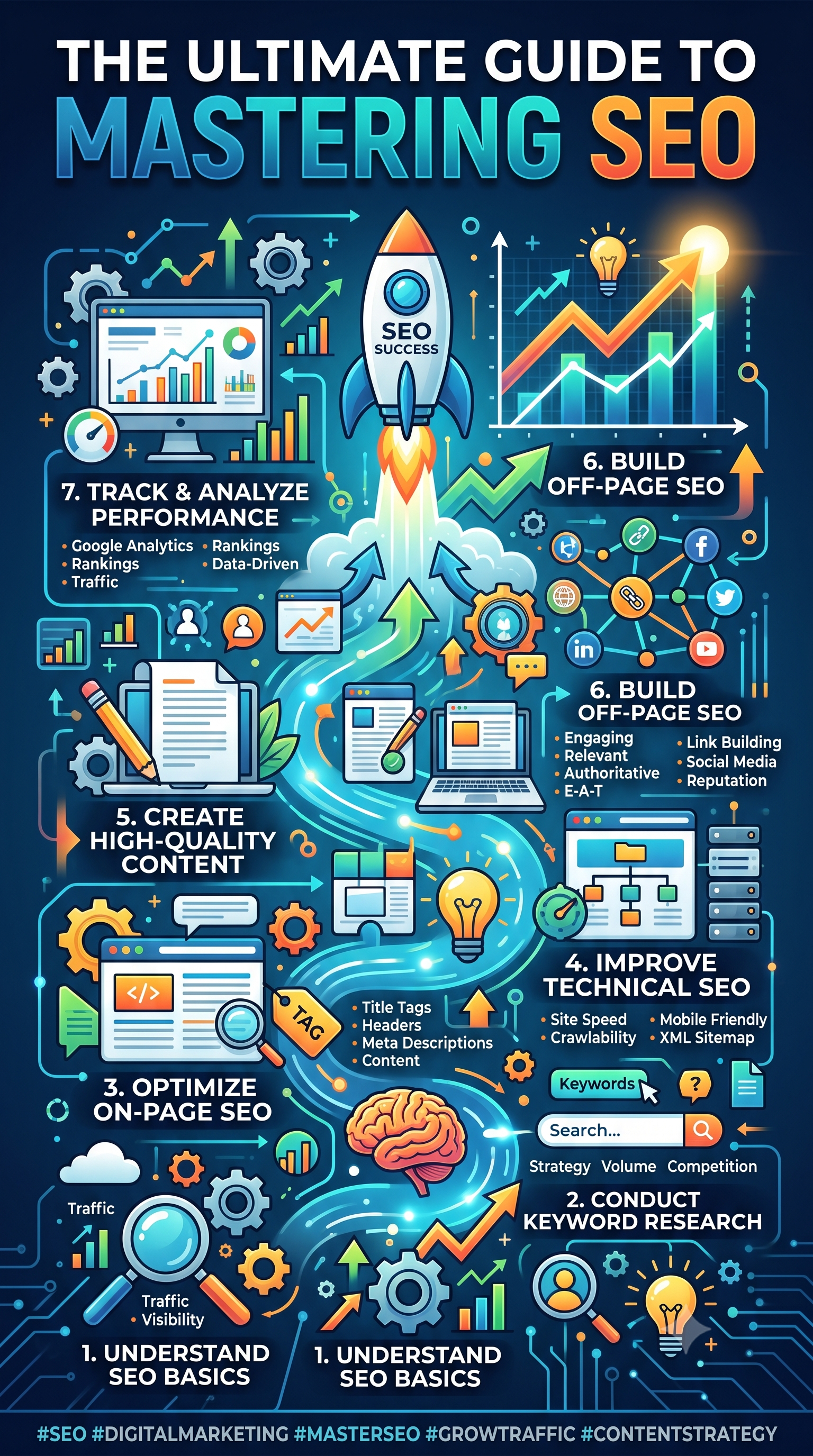
Search Engine Optimization (SEO) remains the most sustainable engine for long-term website traffic, brand authority, and organic growth. As search algorithms evolve to evaluate conversational AI responses, deep contextual relevance, and genuine user satisfaction, traditional keyword-stuffing tactics no longer work.
To dominate search results in 2026, website owners, bloggers, and businesses must adopt a holistic strategy. Modern SEO combines technical infrastructure, topical authority, authentic experience, and optimization for AI-driven search engines (Generative Engine Optimization or GEO).
This guide covers everything required to master SEO in 2026 - from core fundamentals to advanced content architecture and modern search optimization.
Table of Contents
What Is Modern SEO in 2026?
How Modern Search Engines Index and Rank Content
The Shift: Traditional SEO vs. Generative Engine Optimization (GEO)
Understanding Search Intent and User Experience
Building Topical Authority and Topic Clusters
On-Page SEO Best Practices for Blogs
Technical SEO Fundamentals
E-E-A-T: Demonstrating Real-World Authority
Modern Keyword Research and Semantic Entities
Off-Page SEO and High-Trust Link Acquisition
Optimizing for AI Overviews and Zero-Click Searches
Mobile Performance and Core Web Vitals
Content Maintenance: Auditing and Updating Decaying Content
SEO Metrics and KPIs to Track
SEO Strategies for Different Content Types
Step-by-Step SEO Workflow for Bloggers
Frequently Asked Questions (FAQs)
1. What Is Modern SEO in 2026?
Modern SEO is the process of optimizing web pages and digital assets to achieve higher visibility in both traditional search engine results pages (SERPs) and AI-generated answer summaries.
A successful SEO strategy focuses on:
Direct relevance: Accurately answering user queries without filler.
Semantic depth: Covering subjects thoroughly using recognized entity relationships.
Technical precision: Delivering fast, accessible, and easily crawlable code.
Trust signals: Backing up assertions with verifiable experience and authoritative references.
2. How Modern Search Engines Index and Rank Content
Search engines discover, evaluate, and rank web pages through three fundamental phases:
Crawling: Automated bots (like Googlebot) follow links across the web to discover new and updated pages.
Indexing: Search engines parse the page content, analyze code, structure text into semantic concepts, and store it in a massive database.
Ranking and Retrieval: When a user enters a query, algorithms score indexed pages based on intent matching, domain authority, technical performance, and engagement metrics to deliver the best result.
3. The Shift: Traditional SEO vs. Generative Engine Optimization (GEO)
Search engines increasingly synthesize answers directly via AI summaries and conversational answer engines.
Feature Traditional SEO Generative Engine Optimization (GEO) Primary Goal High rank on blue links Citation and inclusion in AI Overviews Keyword Focus Exact-match & long-tail keywords Semantic entities, concepts, and relationships Content Style Comprehensive articles targeting keywords Direct, factual, data-dense, quotable answers Success Metric Click-through rate (CTR) to site Brand impressions, citations, and high-intent traffic Winning in 2026 requires balancing both models: structuring pages so AI engines cite your brand while offering deep analysis that compels readers to click through.
4. Understanding Search Intent and User Experience
Every search query has a specific goal behind it. If your content fails to satisfy that intent within seconds, users bounce, signaling poor relevance to search algorithms.
Informational: The user wants to learn (e.g., how to fix a 404 error). Format as direct tutorials or guides.
Commercial Investigation: The user is comparing options (e.g., best VPS hosting for WordPress). Provide comparison tables and objective pros/cons.
Transactional: The user is ready to purchase or sign up (e.g., buy a domain name). Streamline the path to conversion.
Navigational: The user wants a specific brand or login page (e.g., Cloud India Hub login).
5. Building Topical Authority and Topic Clusters
Publishing isolated blog posts on disconnected subjects dilutes your domain's focus. Search engines reward sites that demonstrate complete coverage of a niche.
[ Pillar Page: The Ultimate SEO Guide ]
| +---------------+---------------+ |
| [ Cluster 1: Technical SEO ]
[ Cluster 2: Keyword Research ] |
[ Cluster 3: Link Building ]
[ Cluster 4: On-Page Optimization ]
Pillar Page: A comprehensive overview page covering a broad topic (e.g., Website SEO).
Cluster Content: Sub-articles exploring specific subtopics in detail (e.g., How to optimize Core Web Vitals).
Internal Linking: Every cluster post links back to the pillar page and laterally to related cluster articles, establishing clear thematic relationships.
6. On-Page SEO Best Practices for Blogs
On-page SEO ensures both crawlers and human readers understand the hierarchy and core takeaways of your article.
Title Tag ($H1$): Place primary keyword near the beginning; keep within 50–60 characters.
Heading Hierarchy ($H2$, $H3$, $H4$): Break content into scannable subtopics. Include secondary keywords naturally.
Direct Answer Buffers: Place the direct answer to the heading query in the first 1–2 sentences immediately following each $H2$.
Meta Descriptions: Write actionable 140–160 character summaries that prompt clicks.
URL Slugs: Keep URLs short, lower-case, hyphenated, and keyword-focused (e.g.,
/seo-guide-2026).Visual Optimization: Use descriptive filenames, WebP format, and descriptive
alttext.
7. Technical SEO Fundamentals
A technically sound website provides the groundwork for content to rank.
XML Sitemaps: Keep clean, updated sitemaps submitted to Google Search Console and Bing Webmaster Tools.
Robots.txt: Ensure search bots can crawl your essential CSS, JavaScript, and content directories while excluding staging or admin URLs.
Canonical Tags: Use
rel="canonical"tags to prevent duplicate content penalties across parameterized or syndicated URLs.Structured Data (Schema Markup): Implement JSON-LD schema (e.g.,
Article,FAQPage,HowTo,Product) to help search engines parse your content and display rich snippets.Secure Sockets Layer (HTTPS): Maintain valid SSL certificates sitewide.
8. E-E-A-T: Demonstrating Real-World Authority
Google uses the E-E-A-T framework (Experience, Expertise, Authoritativeness, Trustworthiness) to evaluate content quality, particularly for sensitive subjects (finance, health, business).
Experience: Show first-hand usage, original photos, unique case studies, and real testing data.
Expertise: Highlight author credentials, job titles, and industry background on dedicated author bio pages.
Authoritativeness: Earn mentions and links from reputable industry publications and peers.
Trustworthiness: Maintain transparent contact information, clear editorial guidelines, and secure infrastructure.
9. Modern Keyword Research and Semantic Entities
Keyword research has shifted from raw search volume to entity mapping and topical coverage.
Entity Identification: Group related concepts, synonyms, and subtopics rather than targeting a single isolated keyword.
Query Difficulty vs. Value: Prioritize keywords that align with high-intent audience problems rather than broad, vanity keywords with low conversion rates.
People Also Ask (PAA) & Forum Mining: Extract common pain points from search features, Reddit communities, and niche forums to address unanswered questions.
10. Off-Page SEO and High-Trust Link Acquisition
Backlinks from authoritative, relevant websites act as votes of confidence for your domain.
Original Research and Data: Publish surveys, benchmarks, and data reports that other publications cite naturally.
Digital PR: Contribute expert commentary to journalist requests, industry roundups, and authoritative publications.
Broken Link Building: Find broken outbound links on relevant resource pages and pitch your working, high-quality guide as a replacement.
Strategic Partnerships: Collaborate with complementary non-competing businesses on joint guides, webinars, and case studies.
11. Optimizing for AI Overviews and Zero-Click Searches
To ensure your blog is cited as a source in generative search summaries:
Use Q&A Formatting: State the question clearly in an $H2$ or $H3$ tag, followed immediately by a concise, authoritative definition or step-by-step summary.
Incorporate Structured Data Tables: Present comparative data (prices, specs, features) in clear HTML tables.
Publish Proprietary Insights: AI engines prioritize unique data, statistics, and verifiable expert quotes over generic rehashed information.
12. Mobile Performance and Core Web Vitals
Mobile-first indexing means search engines evaluate your site based on its mobile version. Core Web Vitals evaluate real-world user performance:
Largest Contentful Paint (LCP): Measures loading speed. Main content should render within 2.5 seconds.
Interaction to Next Paint (INP): Measures page responsiveness to user clicks/inputs. Keep latency under 200 milliseconds.
Cumulative Layout Shift (CLS): Measures visual stability. Keep shift score under 0.1 by specifying image dimensions and avoiding dynamic content injections.
13. Content Maintenance: Auditing and Updating Decaying Content
Search rankings naturally decay over time as competitors publish fresher content. A regular refresh cycle keeps your domain relevant.
Identify Dropping Pages: Track pages losing traffic or impressions over a 6-month window.
Update Outdated Information: Refresh outdated statistics, replace dead links, and test steps against current software versions.
Expand Content Depth: Add newly relevant subtopics, interactive examples, or updated tables.
Consolidate Thin Pages: Merge underperforming posts covering similar intents into a single authoritative guide using 301 redirects.
14. SEO Metrics and KPIs to Track
Measure the performance of your SEO strategy using actionable business metrics rather than vanity numbers.
Organic Impressions & Clicks: Track growth trends via Google Search Console.
Non-Branded Organic Traffic: Monitor how many new visitors discover your site through generic problem-solving queries.
Keyword Ranking Distribution: Track the volume of queries ranking in top-3 and top-10 positions.
Organic Conversion Rate: Measures newsletter signups, sales, or lead submissions originating from organic search.
Average Engagement Time: Identifies whether visitors stay to consume your content or immediately bounce.
15. SEO Strategies for Different Content Types
Content Type Primary SEO Objective Recommended Optimization Tactics How-To Guides Rank for informational intent & featured snippets Numbered steps, clear screenshots, concise summaries Product Roundups Capture commercial search intent Comparison tables, criteria rubrics, pros/cons lists Industry Reports Attain passive editorial backlinks Original data visualizations, downloadable stats, citations Product / Landing Pages Maximize transactional conversion High-speed code, structured review schema, direct CTAs Case Studies Build E-E-A-T and middle-funnel trust Concrete metrics, client context, problem-to-solution narrative 16. Step-by-Step SEO Workflow for Bloggers
Topic Selection: Choose a target keyword and map its primary search intent and related entities.
SERP Analysis: Review the top 5 ranking results to determine average depth, formatting, and missing information gaps.
Drafting & Structural Hierarchy: Outline using clear $H2$/$H3$ headings. Provide direct answers in the first 2 sentences under each section.
Visuals & Tables: Add labeled diagrams, original screenshots, and comparison tables.
Technical Checks: Compress images to WebP, add schema markup, and write a targeted title tag and meta description.
Internal Link Integration: Link out to 3–5 relevant existing articles on your site, and add links pointing to your new post from older related articles.
Post-Publishing Monitoring: Track indexing status in Google Search Console and schedule a content review for 6 months post-launch.
17. Frequently Asked Questions (FAQs)
1. How long does it take for a new blog post to rank on Google?
For established domains, indexing can happen in hours, with stable ranking taking 2 to 6 months. For newer domains, building authority and achieving top positions typically takes 6 to 12 months of consistent publishing.
2. Are meta keywords still used in SEO?
No. Major search engines have ignored the meta keywords tag for over a decade. Focus your optimization efforts on title tags, meta descriptions, heading structure, and on-page content.
3. Does AI-written content hurt SEO rankings?
Search engines reward high-quality content regardless of how it was produced. However, purely automated, generic AI text that lacks unique insights, original research, or first-hand experience often fails E-E-A-T criteria and underperforms.
4. How many words should an SEO-optimized blog post be?
There is no fixed word count requirement. Match the depth needed to satisfy search intent completely—whether that requires a concise 800-word answer or an in-depth 3,000-word guide.
5. What is the difference between an internal link and an external link?
Internal links connect pages within the same website, helping crawlers understand your site architecture and distribute page authority. External links point to third-party domains to back up facts, cite sources, or direct users to additional resources.


Post a Review