

The Ultimate Guide to Mastering SEO: Strategies for 2026
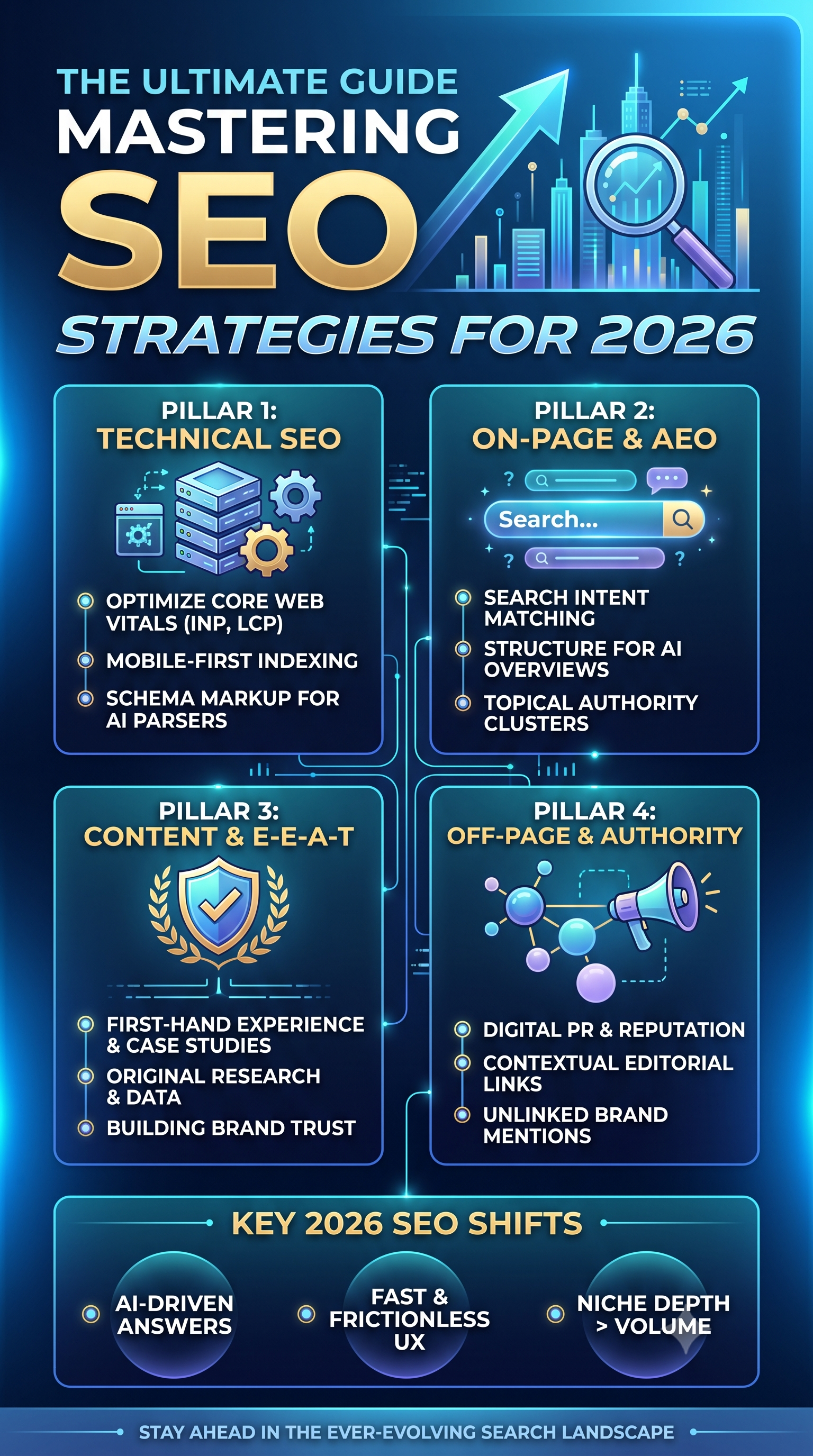
Search engine optimization (SEO) continues to be one of the most important digital marketing strategies for businesses, bloggers, startups, and online brands. But SEO in 2026 is very different from the traditional approach of simply adding keywords to web pages.
Search engines are becoming better at understanding search intent, content quality, user experience, website authority, and the overall usefulness of a page. At the same time, AI is changing how people search for information and how businesses create content.
If you want your website to attract organic traffic, generate leads, build authority, and compete online in 2026, you need a modern SEO strategy.
This ultimate guide explains the most important SEO strategies for 2026, from keyword research and technical SEO to content optimization, local SEO, backlinks, AI search, and performance tracking.
What Is SEO?
SEO, or Search Engine Optimization, is the process of improving a website so that search engines can better understand, index, and rank its pages for relevant searches.
The main goal of SEO is not simply to rank #1. A successful SEO strategy should help you:
- Increase organic website traffic
- Reach the right audience
- Improve search visibility
- Generate qualified leads
- Build brand credibility
- Increase conversions
- Create long-term online growth
SEO combines several areas, including content, technical optimization, website experience, authority, and search intent.
Why SEO Is Important in 2026
Online competition is increasing every year. Businesses are publishing more content, creating new websites, and investing heavily in digital marketing.
In 2026, SEO remains important because users still rely heavily on search engines to discover products, services, businesses, answers, and solutions.
A strong SEO strategy can help your business appear when potential customers are actively searching for what you offer.
Major Benefits of SEO
1. More Organic Traffic
A well-optimized website can attract visitors without paying for every individual click.
2. Better Brand Visibility
Consistent search visibility can help people recognize and trust your brand.
3. Higher-Quality Leads
SEO can target people who are already searching for specific products, services, or information.
4. Long-Term Results
Unlike short-term advertising campaigns, quality SEO work can continue generating traffic over time.
5. Improved User Experience
Good SEO practices often make websites faster, easier to navigate, and more useful.
The Most Important SEO Strategies for 2026
SEO has become a broader discipline. Instead of focusing on one ranking factor, businesses should build a complete search strategy.
1. Focus on Search Intent
One of the most important SEO strategies in 2026 is understanding why someone is searching.
For example, someone searching for:
“best SEO tools”
may be researching different tools.
Someone searching for:
“buy SEO software”
has a stronger commercial or transactional intent.
Common Types of Search Intent
- Informational: The user wants to learn something.
- Navigational: The user wants to find a particular website or brand.
- Commercial: The user is comparing products or services.
-
Transactional: The user is ready to take an action or make a purchase.
How to Optimize for Search Intent
Before creating content, ask:
- What is the user actually looking for?
- What type of content appears for this search?
- What questions does the user want answered?
- What information is missing from existing results?
-
What action should the visitor take after reading?
Pro Tip
Don't create content only because a keyword has search volume. Create content because it solves a real problem for your target audience.
2. Perform Smart Keyword Research
Keyword research remains an important part of SEO, but modern keyword research goes beyond finding high-volume keywords.
You should identify keywords based on:
- Search intent
- Relevance
- Competition
- Business value
- Long-tail variations
- Related questions
-
Topic relevance
Focus on Long-Tail Keywords
Long-tail keywords are usually more specific than broad keywords.
For example:
Broad keyword:
SEOLong-tail keyword:
SEO strategies for small businesses in 2026Long-tail searches can help you target users with more specific needs.
Build Topic Clusters
Instead of creating individual articles that are unrelated, build a group of interconnected content around a main topic.
For example:
Pillar topic:
SEO Guide 2026Supporting topics:
- Keyword Research
- Technical SEO
- On-Page SEO
- Local SEO
- Link Building
- SEO Tools
- Content Optimization
- SEO Analytics
This creates a stronger topical structure for your website.
Create High-Quality, People-First Content
Content remains at the heart of SEO.
However, publishing hundreds of low-quality articles is not an effective strategy. Your content should be created primarily to help your audience.
A good SEO article should be:
- Original
- Helpful
- Accurate
- Easy to understand
- Well-structured
- Relevant to the target audience
-
Updated when necessary
How to Write SEO-Friendly Content
Start with a clear topic and understand the audience.
Then create an outline that answers the user's most important questions.
Use:
- Short paragraphs
- Descriptive headings
- Bullet points
- Examples
- Tables where appropriate
- Relevant internal links
- Clear calls to action
Avoid unnecessarily repeating the same keyword throughout the article.
4. Optimize On-Page SEO
On-page SEO refers to improvements made directly to your website pages.
Important elements include:
- SEO title
- Meta description
- Headings
- URL structure
- Keyword placement
- Internal links
- Image optimization
- Content structure
-
User experience
Optimize Your Title Tag
Your title should clearly communicate what the page is about.
Instead of:
SEO Tips
Use:
15 Effective SEO Strategies to Improve Your Website Ranking in 2026
The second title provides more context and can encourage relevant users to click.
Write Better Meta Descriptions
A meta description should briefly explain the page and encourage users to visit it.
Keep it natural and relevant rather than filling it with keywords.
5. Strengthen Your Technical SEO
Technical SEO ensures that search engines can efficiently crawl, understand, and index your website.
Important Technical SEO Areas
- Website speed
- Mobile responsiveness
- HTTPS
- XML sitemap
- Robots.txt
- Canonical URLs
- Structured data
- Crawlability
- Indexability
- Broken links
- Redirects
-
Core Web Vitals
Mobile-Friendly Websites
A large percentage of online searches happen on mobile devices. Your website should therefore work properly across smartphones, tablets, and desktops.
Make sure:
- Text is readable
- Buttons are easy to click
- Images are responsive
- Navigation is simple
-
Pages load efficiently
Mobile-Friendly Websites
A large percentage of online searches happen on mobile devices. Your website should therefore work properly across smartphones, tablets, and desktops.
Make sure:
- Text is readable
- Buttons are easy to click
- Images are responsive
- Navigation is simple
-
Pages load efficiently
Ways to Improve Website Performance
You can improve performance by:
- Compressing images
- Using modern image formats
- Reducing unnecessary scripts
- Improving server response time
- Using browser caching
- Removing unnecessary plugins
-
Optimizing CSS and JavaScript
7. Build Strong Internal Linking
Internal links connect one page of your website to another.
For example, if you have an article about SEO strategies, you can link to related content about keyword research, technical SEO, or Google Analytics.
Benefits of Internal Linking
Internal links can:
- Help users discover related content
- Improve website navigation
- Help search engines understand website structure
- Distribute internal authority
- Keep visitors engaged with your content
Use descriptive anchor text rather than generic phrases such as “click here.”
8. Earn High-Quality Backlinks
Backlinks are links from other websites pointing to your website.
But not every backlink has the same value.
A relevant link from a trusted website can be much more valuable than a large number of low-quality or irrelevant links.
Ethical Link-Building Strategies
Consider:
- Creating original research
- Publishing useful guides
- Digital PR
- Guest contributions on relevant websites
- Creating valuable resources
- Building relationships with industry websites
-
Promoting original statistics and studies
Avoid Spammy Link Building
Avoid strategies designed purely to manipulate rankings, such as buying large quantities of low-quality links or participating in link schemes.
Focus on earning links because your content is genuinely useful.
9. Optimize for Local SEO
Local SEO is especially important for businesses that serve customers in a specific location.
Examples include:
- Restaurants
- Hospitals
- Salons
- Schools
- Real estate businesses
- Digital marketing agencies
- Construction companies
- Local service providers
Important Local SEO Strategies
- Optimize your Google Business Profile
- Keep business information accurate
- Use consistent business details
- Collect genuine customer reviews
- Create location-specific content
- Build relevant local citations
- Add location pages where appropriate
Local SEO can help businesses become more visible when people search for products and services in their area.
10. Use AI Carefully in Your SEO Strategy
AI has become an important part of digital marketing.
It can help marketers with:
- Content research
- Topic ideas
- Content outlines
- Keyword grouping
- Data analysis
- Content optimization
- Competitor research
However, simply generating large amounts of AI content and publishing it without review is not a reliable SEO strategy.
The Human + AI Approach
A better approach is:
AI for efficiency + Human expertise for quality.
Human review is important for:
- Accuracy
- Original insights
- Experience
- Brand voice
- Fact checking
- Examples
- Context
Your content should provide genuine value rather than simply being produced to increase the number of pages on your website.
11. Optimize Content for AI Search and Search Experiences
Search is becoming more conversational and increasingly incorporates AI-generated answers and summaries.
This means businesses should think beyond traditional blue search results.
How to Prepare Your Content
Create content that:
- Answers questions clearly
- Uses logical headings
- Provides direct explanations
- Includes original insights
- Demonstrates expertise
- Uses structured information
- Covers a topic comprehensively
- Is easy for users and search systems to understand
Don't try to write only for an algorithm. Write for people first while making the content easy for search systems to understand.
12. Improve E-E-A-T Signals
E-E-A-T stands for:
- Experience
- Expertise
- Authoritativeness
- Trustworthiness
These concepts are especially important when users need reliable information.
Ways to Demonstrate Experience and Expertise
You can strengthen your content by including:
- Author information
- Real-world examples
- Original research
- Expert opinions
- Sources and references
- Case studies
- First-hand experience
- Updated information
Trust is especially important for websites dealing with topics that can significantly affect people's lives, finances, or safety.
13. Optimize Images for SEO
Images can improve user experience while also creating opportunities for search visibility.
Image SEO Best Practices
- Use descriptive filenames
- Add meaningful alt text
- Compress large images
- Use appropriate dimensions
- Choose modern formats where suitable
- Avoid unnecessary stock images
- Place images near relevant content
For example:
Instead of:
IMG12345.jpgUse:
seo-strategies-2026.jpgAlt text should describe the image naturally and accurately.
14. Track and Measure SEO Performance
SEO cannot be managed effectively without measuring results.
Important metrics include:
- Organic traffic
- Search impressions
- Click-through rate
- Keyword rankings
- Conversions
- Engagement
- Indexed pages
- Backlinks
- Page performance
Useful SEO Tools
Some commonly used tools include:
- Google Search Console
- Google Analytics
- Google Keyword Planner
- Google Trends
- Bing Webmaster Tools
- SEO crawling and research tools
The most important point is not to focus on rankings alone. Business outcomes matter more than vanity metrics.
Common SEO Mistakes to Avoid in 2026
Even a good SEO strategy can fail if basic mistakes are repeated.
Mistake 1 — Keyword Stuffing
Repeating the same keyword unnaturally can make content difficult to read.
Mistake 2 — Publishing Low-Quality AI Content
AI-generated content without meaningful editing, expertise, or originality may provide little value to users.
Mistake 3 — Ignoring Technical SEO
Excellent content won't perform as well if search engines have difficulty crawling or indexing your website.
Mistake 4 — Buying Low-Quality Backlinks
Large numbers of irrelevant or manipulative links can create SEO risks.
Mistake 5 — Ignoring Mobile Users
A website that works poorly on mobile devices can provide a poor user experience.
Mistake 6 — Forgetting Existing Content
Don't focus only on creating new articles. Regularly review and improve your existing content.
A Practical SEO Strategy for 2026
If you are starting SEO from scratch, follow this simple process.
Step 1 — Understand Your Audience
Identify your ideal customers and their problems.
Step 2 — Research Keywords
Find relevant keywords based on search intent and business value.
Step 3 — Analyze Competitors
Study what successful websites are covering and identify opportunities to provide something better or different.
Step 4 — Create Helpful Content
Build original, useful content that completely addresses the user's needs.
Step 5 — Optimize On-Page SEO
Improve titles, headings, URLs, internal links, images, and content structure.
Step 6 — Fix Technical Issues
Improve crawling, indexing, mobile usability, website speed, and technical health.
Step 7 — Build Authority
Earn relevant mentions, links, reviews, and recognition within your industry.
Step 8 — Measure Results
Monitor traffic, visibility, conversions, and other important SEO metrics.
Step 9 — Improve Continuously
SEO is not a one-time task. Search behavior, competitors, websites, and search technology continue to change.
SEO Checklist for 2026
Use this checklist when optimizing your website:
- Research relevant keywords
- Understand search intent
- Create people-first content
- Optimize title tags
- Write useful meta descriptions
- Use proper H1–H6 headings
- Improve URL structure
- Add relevant internal links
- Optimize images
- Improve website speed
- Check mobile responsiveness
- Submit and monitor your sitemap
- Check indexing issues
- Improve Core Web Vitals
- Build relevant backlinks
- Optimize local SEO
- Review existing content
- Monitor Search Console and Analytics
- Update outdated information
- Focus on conversions, not just rankings
Frequently Asked Questions About SEO in 2026
Is SEO still important in 2026?
Yes. SEO remains an important channel for businesses that want sustainable organic visibility and relevant website traffic. However, modern SEO requires more focus on content quality, user intent, technical performance, authority, and overall search experience.
What is the most important SEO strategy in 2026?
There is no single strategy that guarantees rankings. A strong approach combines helpful content, search-intent optimization, technical SEO, good website experience, authority, and continuous measurement.
Does AI-generated content hurt SEO?
AI itself is not the main issue. The important consideration is whether the resulting content is useful, original, accurate, trustworthy, and created to genuinely help users.
How long does SEO take to show results?
SEO results vary depending on competition, website authority, content quality, technical condition, industry, and the strategy being implemented. SEO should generally be treated as a long-term growth strategy rather than an overnight solution.
Can small businesses compete with large websites?
Yes. Small businesses can compete by focusing on specific audiences, local searches, niche topics, long-tail keywords, strong expertise, and genuinely useful content.
Final Thoughts
SEO in 2026 is no longer about simply inserting keywords into an article and waiting for rankings.
Successful SEO is about understanding your audience, answering their questions, creating valuable content, building trust, improving technical performance, and continuously adapting to changes in search.
Whether you run a small business website, e-commerce store, blog, or professional service website, the fundamentals remain the same: help people first, make your website easy to understand, and build genuine authority over time.
If you consistently apply these SEO strategies and measure what works, you can build a stronger online presence and create sustainable organic growth in 2026 and beyond.


Post a Review