

WhatsApp Marketing Guide 2026:
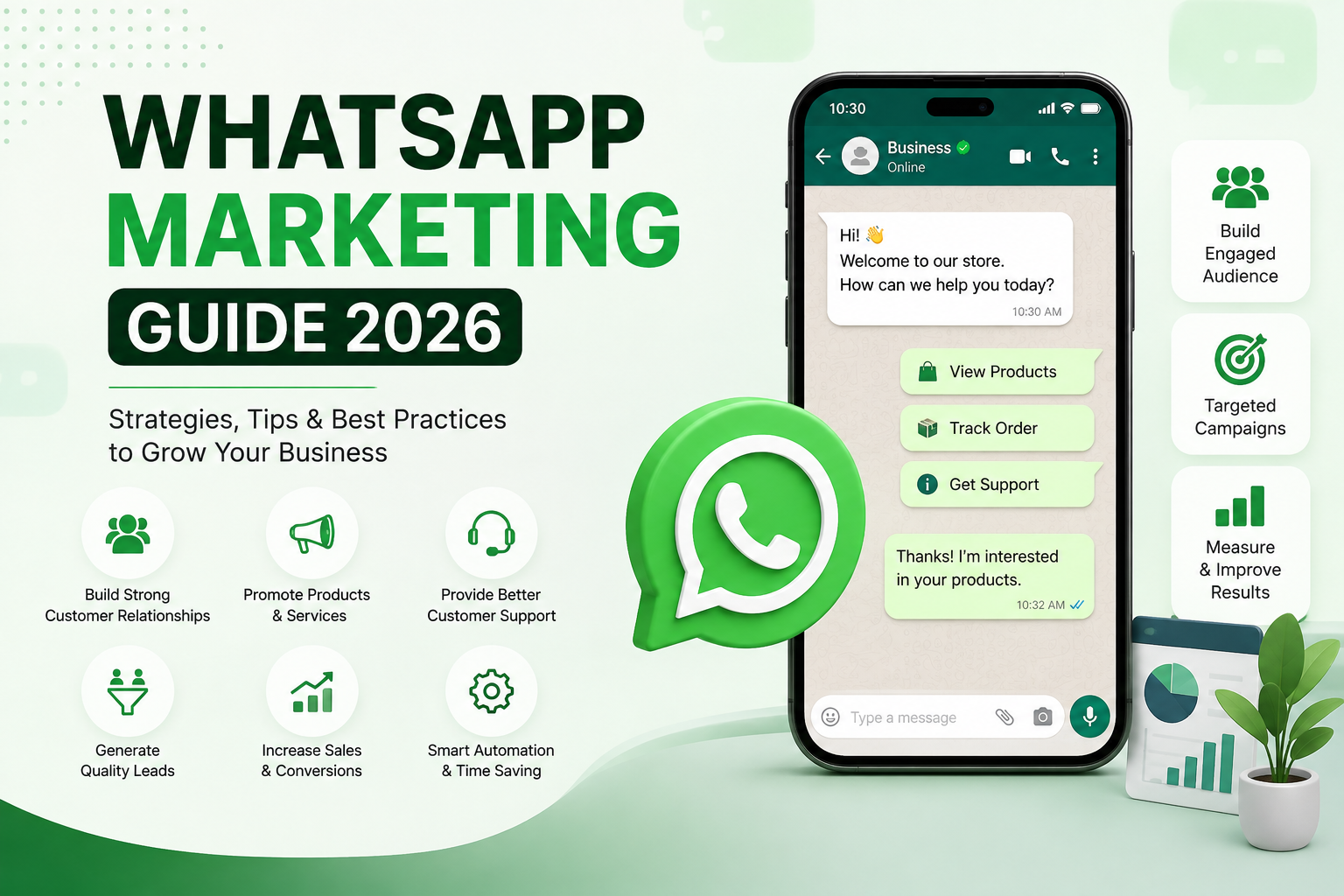
How to Grow Your Business with WhatsApp Marketing:
WhatsApp Marketing Guide 2026 is one of the most practical ways for businesses to connect with customers, generate leads, promote products, provide customer support, and increase sales.
With billions of people using WhatsApp to communicate every day, businesses can use WhatsApp Business and WhatsApp Business Platform to create direct and personalized conversations with customers.
But successful WhatsApp marketing is not simply about sending promotional messages to a large contact list. In 2026, businesses need a well-planned strategy based on customer consent, personalization, useful content, automation, segmentation, and consistent communication.
This complete guide explains what WhatsApp marketing is, how it works, the best strategies to use, common mistakes to avoid, and how businesses can use WhatsApp to generate better results.
What Is WhatsApp Marketing?
WhatsApp marketing is a digital marketing strategy that uses WhatsApp to communicate with existing and potential customers.
Businesses can use WhatsApp to:
- Promote products and services
- Generate leads
- Send offers and updates
- Answer customer questions
- Share product information
- Follow up with leads
- Provide customer support
- Send order and appointment updates
- Build long-term customer relationships
Unlike traditional advertising channels, WhatsApp allows businesses to communicate through direct conversations, making it easier to provide personalized customer experiences.
Why WhatsApp Marketing Is Important in 2026
Customer expectations are changing. People want businesses to respond quickly and provide information through channels they already use.
WhatsApp can be particularly useful because customers can communicate with a business without navigating complicated websites or waiting for traditional support channels.
For businesses, this creates opportunities throughout the customer journey—from the first inquiry to follow-up and repeat purchases.
Key Benefits of WhatsApp Marketing
1. Direct Customer Communication
WhatsApp allows businesses to communicate directly with customers instead of relying only on social media posts or emails.
A customer can ask a question, request a quotation, check product availability, or enquire about a service through a simple chat.
2. Better Lead Follow-Up
Many businesses lose potential customers because leads are not followed up quickly.
WhatsApp can help sales teams communicate with interested prospects and provide relevant information at the right time.
3. Personalized Marketing
Businesses can personalize conversations based on customer interests, previous enquiries, products purchased, or services requested.
Personalized communication can make marketing messages more relevant and useful.
4. Customer Support
WhatsApp can also function as a customer-support channel.
Businesses can use it to answer frequently asked questions, provide updates, collect information, and connect customers with human support when required.
5. Cost-Effective Communication
For many small and medium-sized businesses, WhatsApp provides a practical communication channel without requiring a large marketing infrastructure.
WhatsApp Business vs WhatsApp Business Platform
Before starting WhatsApp marketing, it is important to understand the available options.
WhatsApp Business App
The WhatsApp Business App is suitable for small businesses that manage customer conversations directly.
It provides useful business features such as:
- Business profiles
- Product catalogs
- Quick replies
- Greeting messages
- Away messages
- Labels
- Customer conversations
It can be a good starting point for local businesses, freelancers, retailers, service providers, and small teams.
WhatsApp Business Platform
The WhatsApp Business Platform is designed for businesses that require more advanced communication and automation.
It can support:
- Automated customer communication
- CRM integrations
- Lead management
- Scalable messaging
- Customer service workflows
- Approved message templates
- Automated notifications
Businesses using the Platform need to follow WhatsApp's messaging policies and applicable requirements.
How to Start WhatsApp Marketing in 2026
A successful WhatsApp marketing strategy starts with a strong foundation.
Step 1: Create a Professional WhatsApp Business Profile
Your business profile should clearly communicate who you are and what your business offers.
Include:
- Business name
- Logo
- Business description
- Website
- Email address
- Business category
- Working hours
- Location, where applicable
Keep your information accurate and updated.
Step 2: Build a Permission-Based Customer List
Do not simply collect phone numbers and start sending promotional messages.
WhatsApp's Business Messaging Policy requires businesses to have the person's phone number and their permission to receive further messages from the business on WhatsApp. Businesses must also respect requests to stop receiving messages.
You can build an opt-in audience through:
- Website forms
- Lead-generation campaigns
- QR codes
- Store visits
- Social media
- Landing pages
- Customer enquiries
- Online registrations
- Events
For example:
“Get our latest offers and product updates on WhatsApp. Click here to subscribe.”
The customer should clearly understand what type of communication they are agreeing to receive.
Step 3: Segment Your WhatsApp Audience
Sending the same message to every customer is not an effective strategy.
Instead, divide your audience into relevant groups.
Example Customer Segments
- New leads
- Existing customers
- Repeat customers
- High-value customers
- Interested prospects
- Customers who requested a quotation
- Customers who purchased a specific product
- Customers who have not purchased recently
Segmentation allows you to send more relevant messages.
Step 4: Create Valuable WhatsApp Content
Your WhatsApp marketing should not be only about selling.
Use a combination of promotional and useful content.
Content Ideas
- New product announcements
- Special offers
- Educational tips
- Product demonstrations
- Customer testimonials
- Frequently asked questions
- Industry updates
- Seasonal promotions
- Event invitations
- Helpful guides
- Limited-time offers
A useful message gives customers a reason to continue engaging with your business.
WhatsApp Marketing Strategies for 2026
1. Use Click-to-WhatsApp Ads
Businesses can use Meta advertising to encourage potential customers to start a WhatsApp conversation.
For example:
Ad → WhatsApp Chat → Customer Enquiry → Sales Follow-Up
This can be useful for businesses that depend on enquiries and conversations to generate sales.
Examples include:
- Real estate
- Interior design
- Education
- Automobile businesses
- Fashion
- Restaurants
- Local services
- Digital marketing agencies
2. Use WhatsApp for Lead Generation
WhatsApp can become an important part of your lead-generation funnel.
A simple funnel can look like:
Social Media Ad → WhatsApp → Customer Question → Qualification → Follow-Up → Sale
Prepare answers for common questions such as:
- What is the price?
- Where are you located?
- What services do you provide?
- How can I place an order?
- Do you provide delivery?
- Can I get a quotation?
Fast and useful responses can improve the customer experience.
3. Use WhatsApp Automation
Automation can help businesses manage repetitive conversations.
For example, when a customer sends:
“Hi”
An automated response could provide options such as:
- Product Information
- Pricing
- Book an Appointment
- Talk to Sales
- Customer Support
However, automation should not completely replace human support.
WhatsApp's policy indicates that automated responses can be used during the applicable customer-service window, while businesses should provide a clear and direct way to escalate to human support.
3. Use WhatsApp Automation
Automation can help businesses manage repetitive conversations.
For example, when a customer sends:
“Hi”
An automated response could provide options such as:
- Product Information
- Pricing
- Book an Appointment
- Talk to Sales
- Customer Support
However, automation should not completely replace human support.
WhatsApp's policy indicates that automated responses can be used during the applicable customer-service window, while businesses should provide a clear and direct way to escalate to human support.
4. Follow Up With Leads
Lead follow-up is one of the most important WhatsApp marketing strategies.
For example:
Day 1: Send product information.
Day 2: Answer questions or share useful details.
Day 4: Share a relevant benefit or customer testimonial.
Day 7: Send a suitable offer or invite the customer to continue the conversation.
The goal is not to repeatedly message customers. The goal is to provide relevant information and move interested prospects toward a decision.
5. Use WhatsApp Catalogs for Product Discovery
For businesses selling products, a WhatsApp catalog can make it easier for customers to explore available products.
A good catalog should include:
- Clear product images
- Product names
- Accurate descriptions
- Relevant pricing information
- Product categories
Keep the catalog updated so customers do not receive outdated information.
6. Use WhatsApp for Customer Retention
Marketing should not stop after a customer makes a purchase.
Businesses can use WhatsApp to build long-term relationships through useful communication such as:
- Order updates
- Service reminders
- Product recommendations
- Customer support
- Feedback requests
- Relevant offers
- New product announcements
Retention-focused communication can help turn one-time buyers into repeat customers.
Best Practices for WhatsApp Marketing
Keep Messages Short and Useful
Customers do not want to read unnecessarily long promotional messages.
Instead of:
“Dear valued customer, we are extremely happy to inform you that our company is introducing...”
Try:
“New Offer Available 🎉
Get 20% OFF on selected products this week.
Message us to know more.”
Keep your message clear and easy to understand.
Personalize Your Messages
Whenever appropriate, use customer information to make communication more relevant.
For example:
“Hi Rahul, your requested quotation is ready.”
is more useful than:
“Dear Customer, your quotation is ready.”
Give Customers an Easy Way to Opt Out
If customers no longer want promotional messages, respect their request.
WhatsApp specifically requires businesses to respect requests to stop or opt out of communications.
This also helps protect your brand reputation.
Avoid Spam
Sending too many promotional messages can frustrate customers and increase the likelihood of blocks or reports.
WhatsApp states that businesses should not spam, mislead, deceive, or surprise users with communications.
Focus on quality over quantity.
Common WhatsApp Marketing Mistakes to Avoid
1. Sending Messages Without Permission
Never build a list and message people without proper consent.
2. Sending Too Many Promotions
Your customers are not looking for advertisements every day.
3. Using Irrelevant Content
Send content that matches the customer's interests.
4. Ignoring Customer Replies
If someone responds to your campaign, make sure your team can handle the conversation.
5. Using Misleading Offers
Avoid false discounts, exaggerated claims, or unclear pricing.
6. Not Tracking Results
Without measurement, you cannot know which campaigns are working.
Common WhatsApp Marketing Mistakes to Avoid
1. Sending Messages Without Permission
Never build a list and message people without proper consent.
2. Sending Too Many Promotions
Your customers are not looking for advertisements every day.
3. Using Irrelevant Content
Send content that matches the customer's interests.
4. Ignoring Customer Replies
If someone responds to your campaign, make sure your team can handle the conversation.
5. Using Misleading Offers
Avoid false discounts, exaggerated claims, or unclear pricing.
6. Not Tracking Results
Without measurement, you cannot know which campaigns are working.
How to Measure WhatsApp Marketing Success
Your WhatsApp marketing strategy should be measurable.
Track metrics such as:
- Number of new leads
- Number of conversations
- Response rate
- Qualified leads
- Conversion rate
- Sales generated
- Customer retention
- Cost per lead
- Customer acquisition cost
- Campaign performance
For example:
100 WhatsApp leads → 40 qualified leads → 15 sales
This gives your business a clearer understanding of campaign performance.
WhatsApp Marketing Funnel
A simple WhatsApp marketing funnel can look like this:
Awareness
Facebook / Instagram / Google / Website
↓
Conversation
↓
Qualification
Understand Customer Requirement
↓
Nurturing
Share Relevant Information
↓
Conversion
Quotation / Purchase / Booking
↓
Retention
Support / Follow-Up / Repeat Purchase
This approach turns WhatsApp from a simple messaging application into an important part of a digital marketing strategy.
WhatsApp Marketing Funnel
A simple WhatsApp marketing funnel can look like this:
Awareness
Facebook / Instagram / Google / Website
↓
Conversation
↓
Qualification
Understand Customer Requirement
↓
Nurturing
Share Relevant Information
↓
Conversion
Quotation / Purchase / Booking
↓
Retention
Support / Follow-Up / Repeat Purchase
This approach turns WhatsApp from a simple messaging application into an important part of a digital marketing strategy.
WhatsApp Marketing for Small Businesses
WhatsApp marketing can be particularly useful for small businesses because customer relationships are often the key to generating repeat business.
A local business can use WhatsApp for:
- New customer enquiries
- Appointment bookings
- Product updates
- Local offers
- Customer support
- Order confirmations
- Feedback
- Repeat sales
For example, a salon can use WhatsApp to send appointment reminders, while an interior design company can use it to communicate with leads and share project updates.
WhatsApp Marketing for E-commerce Businesses
E-commerce businesses can use WhatsApp throughout the customer journey.
Before Purchase
- Product information
- Price enquiries
- Recommendations
- Product availability
During Purchase
- Order confirmation
- Payment information
- Delivery updates
After Purchase
- Customer support
- Feedback
- Product recommendations
- Relevant offers
This creates a more connected customer experience.
WhatsApp Marketing in India
WhatsApp is particularly relevant for businesses targeting Indian customers because it is widely used for personal and business communication.
Indian businesses can use WhatsApp marketing for:
- Local businesses
- Online stores
- Education institutes
- Real estate
- Healthcare-related businesses where permitted
- Interior design
- Automobile businesses
- Fashion brands
- Restaurants
- Professional services
Businesses should always ensure that their messaging practices comply with WhatsApp policies and applicable Indian laws.
The Future of WhatsApp Marketing
WhatsApp marketing is moving beyond simple promotional messaging.
The future is likely to focus more on:
- Personalized customer journeys
- Automation
- AI-assisted customer support
- CRM integration
- Conversational commerce
- Lead qualification
- Customer retention
- Omnichannel marketing
The businesses that succeed will not necessarily be the ones sending the most messages. They will be the ones creating the most useful customer conversations.
Final Thoughts
WhatsApp Marketing in 2026 is more than sending promotional messages to customers. It is about creating meaningful, permission-based conversations that help people discover products, ask questions, receive support, and make informed purchasing decisions.
A successful strategy combines WhatsApp Business, audience segmentation, valuable content, personalization, automation, lead follow-up, customer support, and performance tracking.
Start with a clear customer opt-in process, create useful content, avoid spam, respond quickly, and continuously improve your strategy based on customer feedback and campaign performance.
When used correctly, WhatsApp can become an important part of your overall digital marketing strategy and help your business build stronger customer relationships.


Post a Review